

-
Download
Certificate Query
Certificate Query

 2026/11/4 16:21:41
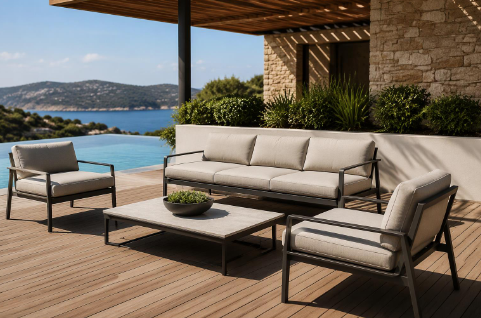
Outdoor living has become an extension of the home: terraces, balconies, pool decks and garden rooms. Buyers increasingly want the comfort of an indoor sofa outside — which is exactly where ordinary upholstery fails.
The difference is not one magical material. It is a construction approach built around water, sun and temperature.
Powder-coated aluminium is the most practical choice: light, rust-free and easy to move. Check wall thickness and weld quality rather than colour.
Teak and other suitable hardwoods age well outdoors if the timber is properly kiln-dried and finished. Cheaper softwoods warp and split.
Wicker and rope need UV-stabilised synthetic versions; natural rattan does not survive sustained rain.
Stainless steel hardware and fixings prevent rust stains at joints.
Quick-dry foam is formulated with an open cell structure so water drains rather than sits. Standard upholstery foam absorbs water and can take days to dry.
Drainage paths — cushion covers need mesh panels or drainage channels; solid covers trap water.
Removable covers let owners clean and replace them, extending the life of the set.
Cushion storage matters; even quick-dry cushions last longer if stored during heavy rain and winter.
Solution-dyed acrylic and similar outdoor textiles resist fading and mildew; the colour goes through the fibre rather than sitting on the surface.
Look for UV resistance and colourfastness data, not just a marketing label.
Avoid standard indoor upholstery, even performance fabrics designed for indoor use; they are not built for continuous wetting.
Dark colours absorb heat and can be uncomfortable in strong sun; light neutrals stay cooler.
Drainage holes in seat platforms so water does not pool under cushions.
Raised seating off the ground for airflow and drying.
Tapered or sloped seat decks to shed water.
Replaceable glides and feet to protect terraces and allow levelling.
Modular connections that stay tight despite expansion and contraction.
Accessible cushions that can be removed easily for storage.
Frame material and finish, with corrosion resistance expectations.
Foam type and drainage design.
Fabric composition, UV performance and cleaning instructions.
Cushion storage recommendations.
Spare covers and replacement parts availability.
Clear guidance on what the product is not suitable for (indoor use is fine, but not constant wet).
Ask for a sample of the actual production fabric and foam.
Confirm the frame is fully welded, not merely screwed, at load-bearing joints.
Check that cushions do not hold water after a simulated rain test.
Review packaging for outdoor products: moisture protection matters in transit.
Confirm warranty terms for fading and water damage, which are often excluded.
Outdoor furniture is bought for lifestyle but judged by weather. Specifying drainage, UV stability and repairability is what separates a set that lasts from one that is replaced in two summers.




Copyright www.hzfgfurniture.com. All Rights Reserved. 浙ICP备2026006019号
