

-
Download
Certificate Query
Certificate Query

 2026/10/19 17:52:45
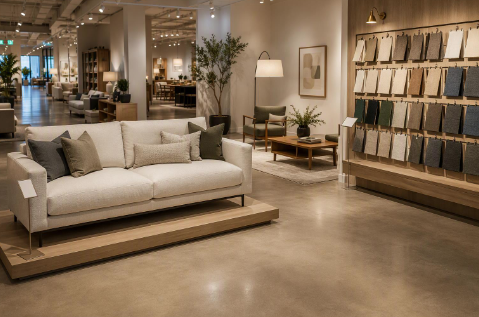
Online shoppers can compare prices and dimensions, but they cannot feel a seat cushion or judge the depth of a sofa. That is why showrooms still matter for furniture retail — and why the difference between a profitable floor and a warehouse with sofas in it usually comes down to planning.
Good merchandising is less about decoration than about how a customer moves, sits and decides. It also has to survive daily cleaning, delivery and re-merchandising.
Retail floors often group products by supplier or collection. Customers do not shop that way. A more effective layout follows the decision sequence:
Entry / hero zone — one strong sofa that sets the price and style level of the store, visible from the entrance.
Lifestyle vignettes — the sofa in context: rug, coffee table, side table, lamp, artwork. These help customers judge scale and combination.
Fabric and finish wall — the full range presented as a wall or sample library, easy to touch and compare.
Price ladder — a clear progression from entry to premium, so the customer understands what extra money buys.
Consultation corner — a quieter seat with a small table, where the final decisions and fabric choices happen.
Clearance or quick-delivery area — for stock pieces and end-of-line items, kept separate so it does not dilute the main offer.
Keep walkways generous enough for two people to pass and for a delivery trolley. Sightlines from the entrance should reveal several zones without a maze of partitions.
Customers cannot judge comfort from six feet away. Design the floor so they can:
Access sofas from the front and side, with no barrier or rope.
Sit and recline fully — leave space for a recliner to open, and mark that space on the floor plan.
Compare seat depths and heights directly; place a deep lounge sofa and a firmer, more upright model near each other.
Touch the fabric: swatches at eye level, larger sample squares, and a note of cleanability or performance rating.
See the mechanism on sleeper sofas and recliners; a working demonstration reduces doubt far more than a specification sheet.
Judge scale with a mirror or a marked floor template showing how the sofa would sit in a typical room.
Lighting matters: use warm, layered lighting rather than flat overhead light, and check how fabric colours look under it. A fabric that looks grey in the store and blue at home creates returns.
Merchandising is not a one-off installation:
Rotate hero pieces and re-style vignettes seasonally without changing the floor structure.
Keep a cleaning kit suited to each fabric on site; a stained display sofa loses value quickly.
Protect walkway corners and sofa arms from trolleys and samples.
Train staff to demonstrate mechanisms, explain fabric care and quote lead times accurately.
Display dimensions and delivery information clearly — size-related returns are the most preventable ones.
Keep point-of-sale material restrained: one clear price ticket and one short feature card per pad rather than a forest of labels.
For suppliers and importers, this is also a useful brief: a retailer that sells well needs consistent colour across repeat orders, reliable fabric availability and a sample programme that lets the floor update without re-ordering whole ranges.
A showroom that helps customers sit, compare and imagine the sofa in their own room will outsell a floor that only shows product. The layout is the cheapest sales tool available.




Copyright www.hzfgfurniture.com. All Rights Reserved. 浙ICP备2026006019号
