

-
Download
Certificate Query
Certificate Query

 2026/10/19 17:50:29
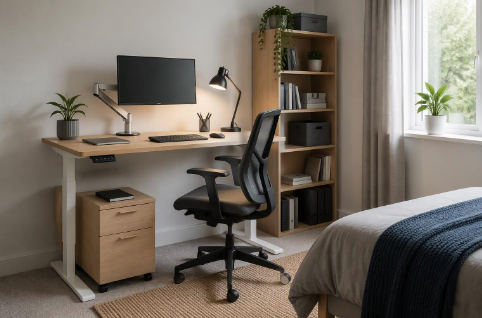
Office furniture used to be sold to facilities managers in large, considered orders. Home office furniture is sold to individuals, often in a hurry, often online, and often for a corner of a bedroom. That changes everything about what a retailer or distributor should carry.
The category is also crowded. The way to compete is not a huge catalogue but a tight range that covers the most common spaces well, supported by clear information and easy assembly.
For most markets, a compact range can be built around five product types:
Compact desks, roughly 100–120 cm wide — the workhorse size for apartments and spare rooms. Slim depth matters: 50–60 cm keeps a room usable.
Height-adjustable desks — a growing segment, but specify motor quality, lift capacity and stability at standing height. Cheap frames wobble and generate returns.
Ergonomic task chairs — adjustable seat height is the minimum; seat depth, lumbar support and armrests define the mid and upper tiers.
Storage that fits the room — filing pedestals, slim bookcases, mobile drawer units and monitor risers. Storage is often the add-on that lifts order value.
Accessories — laptop stands, footrests, cable trays and monitor arms. Low freight cost, high margin, and they solve the "my neck hurts" problem that drives the purchase.
A three-tier price structure works well: an entry range for students and occasional use, a mid range for daily remote work, and a premium tier for professionals who spend most of the day at the desk.
A few practical rules keep a home office range profitable:
Limit SKUs. Three desk sizes and three chair models in consistent colours are easier to stock, photograph and support than twelve variations.
Design for flat-pack freight. Knock-down desks and carton sizes that fit standard parcel networks reduce landed cost and damage claims.
Write assembly instructions for one person. Most buyers assemble alone; unclear steps cause returns and bad reviews.
Check the packaging for e-commerce. A product that arrives with a crushed corner is a refund, even if the furniture is fine.
Keep spare parts. Gas lifts, castors, glides and fixings are the parts customers ask for first.
Provide real specifications. Desk height range, load capacity, chair adjustment ranges and warranty terms are the information shoppers compare before buying.
In store, a single fully assembled workstation sells more than a row of boxed products. Let customers adjust the chair and raise the desk; show the difference between a fixed and a height-adjustable model.
Online, use consistent photography and state dimensions clearly — including the footprint when the chair is pushed in and the space needed behind a reclining chair. Offer a fabric or finish sample service where possible.
For distributors, ask suppliers for:
Consistent colour matching across repeat orders
Replacement-part availability
Carton dimensions and container loading data
Compliance documents for the target market
A sample policy that allows one unit per model before a bulk order
Home office is not a seasonal trend any more. It is a category with repeat buyers, replacement cycles and strong accessory attach rates — provided the range is small enough to manage and specific enough to solve a real space problem.




Copyright www.hzfgfurniture.com. All Rights Reserved. 浙ICP备2026006019号
