

-
Download
Certificate Query
Certificate Query

 2026/9/18 15:14:59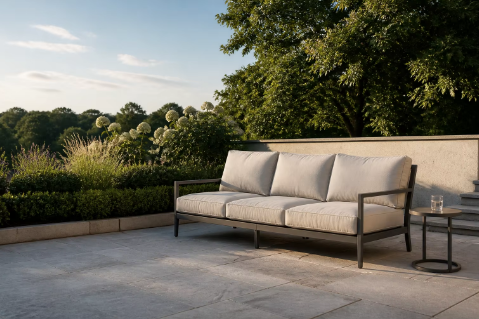
Buyers sourcing patio ranges want to know whether a sofa is built for the weather or simply an indoor model placed outside. The five questions below cover the construction differences that matter, which frames and fills survive sun and rain, how cushions stay dry in humid markets, what to check on a sample, and how these sofas pack and ship.
A genuine outdoor sofa is built around drainage, drying and sun exposure, not just a weatherproof cover. The frame is usually aluminum, powder-coated steel or a rot-resistant timber such as teak, with stainless or galvanized fasteners that will not rust. The seat platform is drilled or slatted so water passes through instead of pooling, and the foam is open-cell so it drains and dries rather than holding water against the cover.
Aluminum is the safest frame for coastal and humid markets because it cannot rust, though it must be powder-coated or it will pit. Teak and similar dense hardwoods weather to a silver gray and can be oiled back, while cheaper softwoods rot at the joints. For cushions, specify solution-dyed acrylic or olefin covers, which hold color under UV, and quick-dry foam wrapped in a drainage layer rather than standard indoor polyurethane.
Three things do the work: covers that shed water, open-cell foam that drains, and a design that lets air move under and between the cushions. Mesh or spacer fabric on the underside helps, and cushions should be stood on edge after rain rather than left flat. In very humid markets many buyers specify cushions with removable covers and store them indoors during the wet season, which prevents mold entirely.
Put the sample through what the weather will do to it. Check that the frame welds are smooth and the coating even, that the seat pan drains without pooling, and that cushions dry overnight rather than staying damp. Confirm the fabric's UV and water-repellent finish by asking for the technical sheet, test the zip and cover removal, and check that fasteners, feet and glides are the corrosion-resistant grade specified rather than a substitute.
Outdoor sofas usually ship knocked down: loose cushions compressed and packed separately, frames nested or stacked, and legs detached. Aluminum frames are light, so container volume rather than weight sets the freight cost, and modular pieces generally load denser than a fixed three-seater. Ask for the packed carton dimensions and a loading plan during quotation, and be aware that cushions, which are mostly air, can account for a large share of the total volume.
Bottom line: An outdoor sofa is a drainage and material decision, and a patio range only performs outdoors if the frame, foam and fabric were all chosen for weather.




Copyright www.hzfgfurniture.com. All Rights Reserved. 浙ICP备2026006019号
