

-
Download
Certificate Query
Certificate Query

 2026/9/18 14:43:27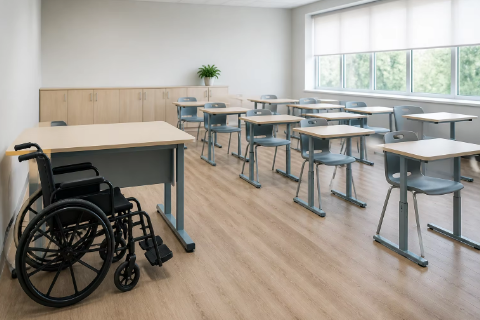
School administrators, district procurement officers and inclusive-education coordinators raise a consistent set of questions when they buy accessible school furniture. The five below cover what accessibility actually demands from classroom furniture, which items matter most, how to specify adjustable-height pieces for a mixed-ability class, the mistakes buyers repeat, and how to verify requirements before an order is placed.
Accessibility requires that every student can reach, enter, use and leave a workstation without assistance. In practice that means clear knee and toe space under the desk, a work surface reachable from a seated position, an aisle wide enough for independent movement, and edges and corners that do not catch clothing or equipment. Height range matters as much as width. Accessibility is a property of the whole room layout, not of one special desk placed at the back.
Desks and chairs carry most of the risk because students spend the day in them, but three other items are routinely overlooked. A fixed-height science bench or art table with a front rail cannot be used from a wheelchair, so a height-adjustable or open-front version matters. Storage and lockers need handles and shelf heights a seated student can operate. Coat hooks, tray trolleys and door-adjacent furniture need clearance so the circulation path stays passable.
Specify one height range wide enough to cover the shortest and tallest user in the room, then confirm the mechanism holds under load at every position. Put a stated adjustment range in millimetres, the load it must support, whether adjustment is tool-free, and how many units per room staff can adjust rather than students. Ask that desks in the accessible row have an open front frame, so knee space is never blocked by a stretcher or crossbar.
The most common mistake is ordering one disabled-access desk per classroom and treating the requirement as met. Others buy furniture that adjusts in height but still has a closed front, a deep apron or a front crossbar, which defeats knee clearance. Buyers also accept catalogue photos as proof, skip the aisle-width check against the room plan, and forget that castors and glides change the effective seat height. Specify clearance dimensions, not product names.
Ask for a dimension drawing showing knee clearance, work-surface height range, aisle footprint and load rating, then check each number against your accessibility standard or the brief from your facilities team. Request a sample, or a factory photo of the actual adjustable unit at its lowest and highest settings. Where possible, test one unit with the wheelchair or seating the student uses. Write the agreed dimensions into the purchase order so they become a contractual specification.
Bottom line: Accessibility is decided by dimensions and clearances, so verify the drawing before you sign rather than after the furniture reaches site.




Copyright www.hzfgfurniture.com. All Rights Reserved. 浙ICP备2026006019号
