

-
Download
Certificate Query
Certificate Query

 2026/9/16 14:57:14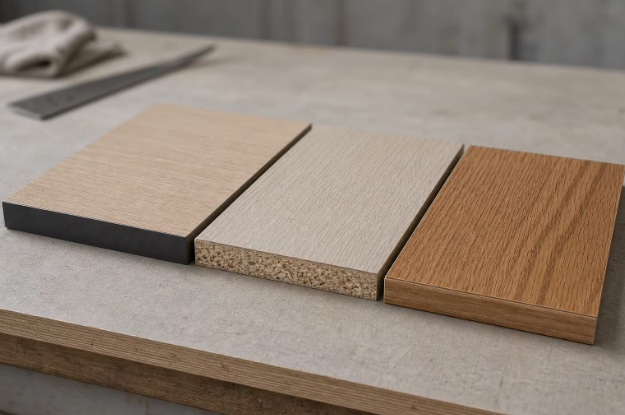
Melamine is a decorative paper saturated with resin and pressed directly onto a particleboard or MDF core, so surface and substrate become one panel. Laminate is a separate high-pressure sheet bonded to a core with adhesive, which makes it thicker and denser and gives better impact resistance. Veneer is a thin slice of real timber glued to a core and finished with lacquer or oil, producing genuine grain that can be sanded and refinished.
The manufacturing route also sets the limits of each product. A pressed melamine panel cannot be sanded back without cutting through the decor layer, while a laminate sheet can be replaced only by re-facing the whole top.
Day-to-day performance differs most at the edges. Moisture reaches a panel through an exposed core, so edge banding quality matters more than the face finish on a desk that will be cleaned often.
Melamine resists light scratches and daily cleaning but chips at unprotected edges
Laminate takes harder wear, including pen pressure and impact, and tolerates repeated cleaning
Veneer shows the finest grain detail and can be repaired locally, but is the least forgiving of standing water
Ask how the banding is applied and how thick it is. A thick band with a matching radius survives contact from chairs and trolleys far better than a thin tape, and on curved or shaped tops the banding method should be confirmed in writing.
Colour consistency across a batch is a sourcing question, not a design one. Decor papers and laminates are produced in lots, and a later reorder can fall into a different lot. For multi-phase projects, agree a shade tolerance and ask for panels to be cut from the same batch where possible.
Cost positioning follows the same line. Melamine sits at the entry and mid-market, laminate occupies the durable mid and upper tiers where cleaning and heavy use are expected, and veneer serves premium and hospitality-led specifications where grain and finish are part of the sale. Buying decisions should follow the environment a desk will actually live in, plus the buyer's expectation for repair three years after installation.
Melamine is a pressed single panel; laminate is a bonded sheet; veneer is real timber over a core.
Edge banding quality decides moisture resistance more than the face finish does.
Agree batch and shade tolerance for multi-phase projects before production.
Match finish to environment and price band rather than to appearance alone.




Copyright www.hzfgfurniture.com. All Rights Reserved. 浙ICP备2026006019号
