

-
Download
Certificate Query
Certificate Query
 2026/9/16 14:55:41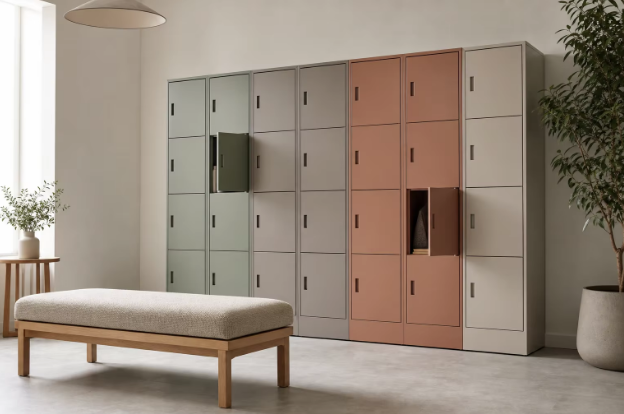
When desks are shared, the desk can no longer act as private storage. Staff attending two or three days a week still need somewhere to leave a bag, jacket, laptop and shoes between visits, and hot-desking policies remove the personal pedestal that once absorbed that clutter. Personal storage becomes a budget line rather than an add-on.
The demand profile also differs from a filing specification. Lockers are sized around personal items instead of documents, counted per person rather than per team, and frequently specified against bench seating so the locker wall doubles as a zone divider.
Bodies are quoted by width, commonly around 300 mm, 400 mm and 450 mm, with one to four doors in a single carcass. A depth of roughly 450 to 500 mm lets a jacket hang without crushing. Tier height should follow what is actually stored:
One tier for coats, helmets and bulky bags
Two tiers for commuters carrying a bag and a laptop
Three or four tiers for shift-based or high-turnover sites
Lock type drives both price and management effort. Key locks are the cheapest option but require a key register. Mechanical combination locks remove keys and the lost-key problem. Digital and RFID locks allow allocation through software, which suits sites that reassign lockers often. For contract work, confirm the lock is field-replaceable and that spares can be ordered years later.
Lockers work hardest when built into a zone. A common arrangement places the run directly behind a bench, so the bench fixes the locker line and the carcass separates circulation from the work area. Confirm plinth height and the gap above the top tier before the wall is drawn.
Shipping format changes landed cost. Flat-packed lockers cut container volume sharply but move assembly to the destination, which needs tools and labour. Assembled units install straight from the carton but occupy far more container space per unit.
Size the order from peak attendance rather than total headcount, add margin for growth and visitors, and settle the allocation policy — assigned or shared — before production starts.
Hybrid attendance turns the private pedestal into a shared-storage problem.
Match tier height to what staff actually store, not to the smallest carton.
Confirm lock field-replaceability and spare-part availability before ordering.
Plan locker count from peak attendance, not total headcount.




Copyright www.hzfgfurniture.com. All Rights Reserved. 浙ICP备2026006019号
