

-
Download
Certificate Query
Certificate Query

 2026/9/16 14:58:36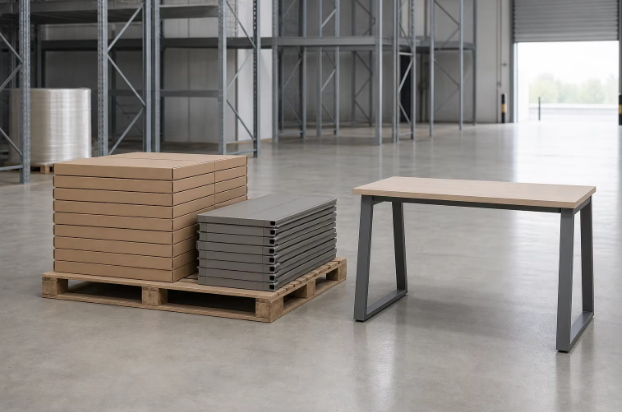
Flat-pack wins on volume. A knock-down desk breaks into a top, a set of frames and a hardware bag, and those components nest against each other, so a container carries far more units than the same order shipped assembled. Because sea freight is charged largely on volume, the saving appears immediately in the quotation and is easy to demonstrate to a customer.
Utilisation also improves when carton sizes are standardised. A supplier that packs tops and frames to two or three consistent carton footprints makes loading plans predictable, whereas mixed carton sizes leave gaps that cost money on every shipment.
The saving shifts rather than disappears. Flat-pack furniture needs a destination process: a bench, tools, instructions in the local language and someone to check each unit before handover. Assembly time per desk is usually short, but the local hourly rate and the quality of the process decide whether the total beats assembled freight.
Label every carton so parts can be matched to a single unit
Seal fasteners in an itemised bag, with spares included
Supply instructions in the destination language with clear diagrams
Agree a bolt, cam and screw specification that allows re-tightening
Hardware is where most complaints originate. A bag missing one bolt turns an assembled desk into a service call, and non-standard fasteners make later repairs difficult.
Flat-pack cartons handle transit reasonably well because panels protect each other, but edge damage on a top is highly visible and quickly becomes a claim. Assembled units are more rigid, yet they can still shift in transit, and a scratched carcass cannot easily be re-packaged.
Assembled shipping remains the better commercial choice when freight rates are low, destination labour is expensive or scarce, the buyer is an end user rather than a dealer, or the product is factory-glued in ways that cannot be reproduced on site.
To cost the trade-off, compare three figures per unit: freight per unit, destination assembly labour, and the expected cost of transit damage and claims. Then specify packing, hardware and documentation for whichever format produces the lower total.
Flat-pack trades container volume for destination labour; cost both sides per unit.
Standard carton footprints make loading plans predictable and reduce wasted space.
Hardware completeness and clear instructions prevent most assembly complaints.
Assembled shipping still wins on short routes, costly labour and fragile products.




Copyright www.hzfgfurniture.com. All Rights Reserved. 浙ICP备2026006019号
