

-
Download
Certificate Query
Certificate Query

 2026/9/16 14:39:18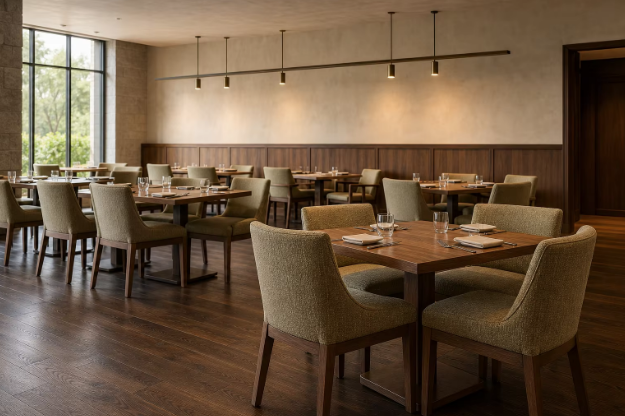
Restaurant seating lives a harder life than any guest room chair. It is pulled in, pushed back and slid across hard floors, and lifted by staff between covers. That constant movement, not the seated weight of a diner, is what loosens joints and wears finishes.
The rear legs and the joint between the back post and the seat frame carry most of the load. Look for reinforced corner blocks, dowelled or mortise-and-tenon joints, and a frame that stays rigid when twisted by hand. Metal frames resist racking; hardwood feels warmer but demands tighter control of glue lines and moisture content. Front legs need glides matched to the floor finish, because a worn glide turns every chair into a scraper.
Stackability suits breakfast rooms, all-day dining and any outlet that must be cleared and reset. Fixed-base chairs and banquettes suit dinner service where seating positions stay constant. Many projects combine both: banquettes along the walls, stackable chairs across the open floor.
The detail behind most guest complaints is the relationship between seat and table height. A standard dining table suits a seat height in the region of 450 mm, leaving roughly 250 to 300 mm of knee clearance under the apron. Lower the table slightly and a padded seat becomes uncomfortable; add a thick cushion and it may sit too high. Approve chairs and tables as a pair, on one drawing, with cushion compression accounted for.
Table tops take cutlery, hot plates and constant wiping. High-pressure laminate with a sealed edge, solid surface and compact laminate all perform well; veneer looks richer but needs a durable finish and a tolerant cleaning regime. Edge profile matters as much as the surface — a sharp square edge chips and collects grime, while a radiused edge survives trolleys and chair backs.
Banquettes are a separate discipline. The seat platform should be ventilated so spills drain instead of sitting against the frame, and the back panel needs a rigid substrate so it does not flex under repeated contact. Confirm the reupholstery route before ordering:
Upholstered panels that unclip or unscrew for replacement
Removable seat cushions with replaceable foam
A small stock of the dining fabric held for future repair
Access hatches to reach banquette fixings
Restaurant seating fails at joints and glides, not at the cushion.
Seat height and table height must be approved together as one set.
Edge profile and top material decide how table tops age under daily wiping.
Banquette construction and on-site reupholstery access should be confirmed before the order.




Copyright www.hzfgfurniture.com. All Rights Reserved. 浙ICP备2026006019号
