

-
Download
Certificate Query
Certificate Query

 2026/9/16 14:41:51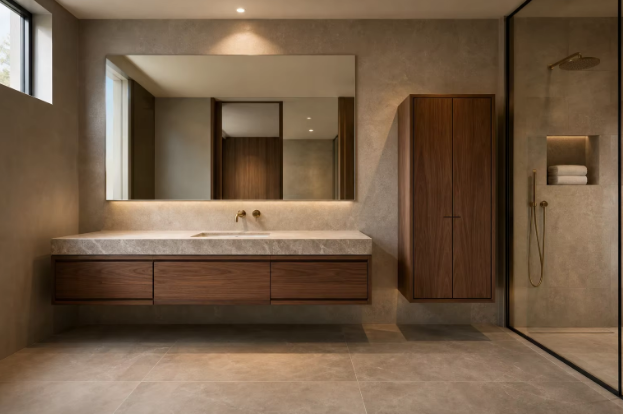
Bathroom joinery faces conditions no other guest room furniture sees. Steam, splashes, spilled toiletries and daily wet wiping combine with weak ventilation to push moisture against every surface, including the ones nobody inspects. A carcass built for a dry bedroom may use a standard board with a thin decorative face; once water reaches an unsealed edge or a fixing hole, that board swells, the face lifts and the door stops closing cleanly.
The failure is usually reported as a hardware fault, but the cause is water ingress. Treat the vanity as a wet-area product, not a bedroom casegood with a basin set into it.
Moisture-resistant boards are the sensible baseline, typically a moisture-resistant MDF or plywood core with sealed faces. A marine-grade plywood or compact laminate carcass suits units placed directly beside a shower enclosure, or rooms without mechanical extract.
Edge treatment deserves as much attention as the panel. Every cut edge should be fully sealed, including edges hidden inside doors, around drawer boxes and at the plumbing cut-outs. At the floor, a sealed or removable plinth shields the carcass base from mopping water.
Countertop options behave differently:
Solid surface: seamless joints, repairable in place, accepts an integral upstand and basin
Engineered stone: hard-wearing and consistent, though joins and repairs show more
Natural stone: premium appearance, but needs sealing and stain management
High-pressure laminate: cost-effective, provided the edge and exposed core are protected
Under-mount basins keep the top easy to wipe and remove the rim seal where water collects.
Steel hardware should be finished for humid interiors; thinly coated steel corrodes at the hinge screws before it fails structurally. Soft-closing hinges and runners should be adjustable and replaceable from the room side, because a fitted vanity is far harder to remove than a freestanding drawer unit.
Mirrors and lighting are often integrated into the same item. Backlit mirrors and vanity lighting both need a service route for cabling and a driver reachable without dismantling the countertop.
Finally, ask which bathroom cleaners the operator uses. Descaling and anti-mould products are aggressive and will dull some top finishes or attack metal trim. Confirming chemical compatibility, and holding spare hardware with the engineering team, protects the room long after handover.




Copyright www.hzfgfurniture.com. All Rights Reserved. 浙ICP备2026006019号
