

-
Download
Certificate Query
Certificate Query

 2026/9/11 17:09:39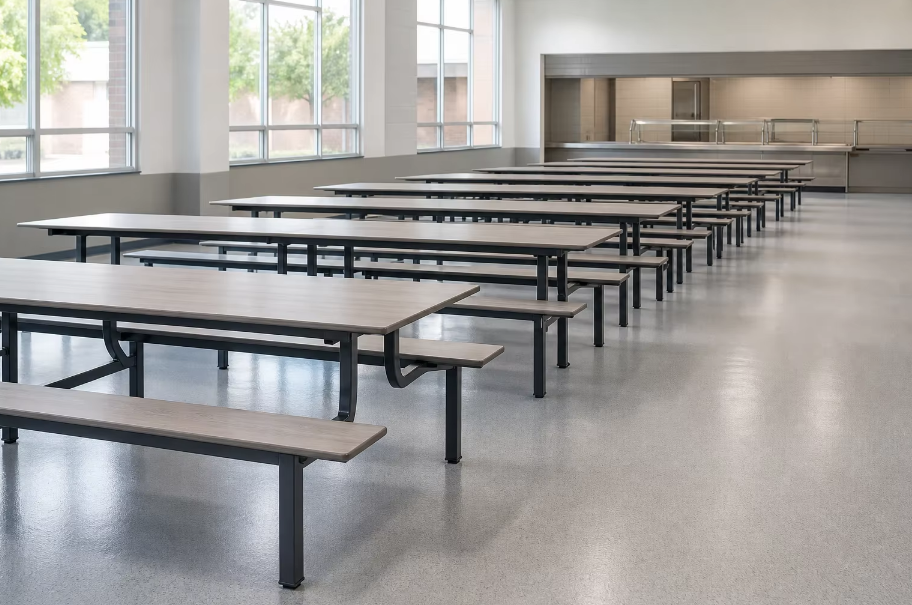
Cafeteria furniture comes down to two buying decisions: a fixed table with seating attached to the frame, or a folding table that clears the floor between uses. Fixed units suit dedicated dining halls where the layout rarely changes — they resist being dragged out of position and keep every seat aligned with the table edge. Folding tables are the better choice where the same room hosts assemblies or exams, but the hinge and locking mechanism is then the part most likely to fail first, so it deserves the closest inspection.
Frame finish decides how long a table survives years of cleaning. Powder-coated steel is common; check that the coating wraps the entire tube, including welded joints and cut ends, because exposed metal at those points is where rust starts. School cleaning chemicals are often harsher than domestic products, so ask suppliers for a written finish and cleaning declaration instead of assuming a standard.
Wear points are predictable: the table edge, the seat front, the hinge bracket and the floor-contact feet. Seating type matters too. Bench seating suits continuous service and is harder to tip; individual stools allow more flexible spacing but move independently and need their own stability check.
Spacing and stability points worth confirming:
Allow enough seat-to-table depth for a tray and both elbows
Keep a clear aisle width for trolleys and evacuation routes
Confirm the unit resists tipping when weight sits on one bench end
Check that feet can be adjusted where floors are uneven
Choose fixed benches for permanent dining halls, folding tables for multi-use rooms.
Inspect coating coverage at welds and cut tube ends, not only the visible frame.
Test tipping stability at the bench end, not just at the centre.
Confirm seat spacing and aisle widths against real traffic flow, not a catalogue drawing.




Copyright www.hzfgfurniture.com. All Rights Reserved. 浙ICP备2026006019号
