

-
Download
Certificate Query
Certificate Query

 2026/9/11 17:11:01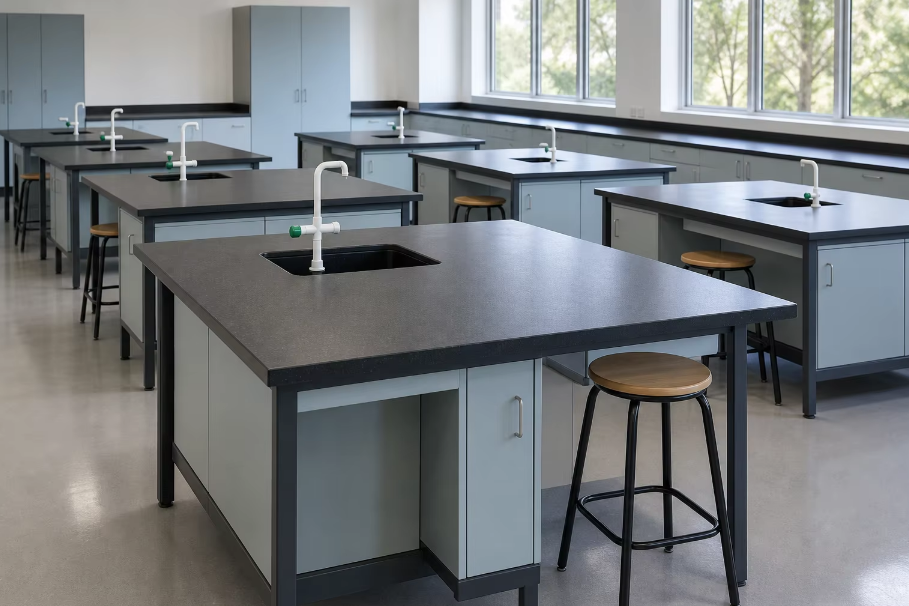
The worktop is the first specification decision in any science lab project. Resin-composite tops resist a broad range of chemicals and tolerate hot apparatus better than laminate, which is usually reserved for light teaching use. Whatever the material, the surface should be non-porous and easy to wipe down, and the front edge should be treated so spills do not run straight off onto the floor.
Service provision shapes the bench layout as much as the room does. If a bench needs a sink, taps, gas or electrical outlets, those services have to be planned into the top rather than retrofitted later. Decide early whether services are shared between two facing benches or provided per student position, since this changes both the bench footprint and the plumbing runs through the room.
Adjustable-height benches let one room serve different year groups, but the adjustment mechanism has to be robust enough for daily use — a common weak point in cheaper frames. Stools should be specified with the top height in mind so students can sit with feet supported and still reach the work surface comfortably.
Storage and mobility complete the picture. Under-bench cupboards keep apparatus and chemicals out of the way, and castors make a lab flexible if the floor is level enough to allow it. Lockable storage is worth having wherever chemicals are kept.
Points worth agreeing at specification stage:
Worktop material matched to the chemicals actually used
Perimeter and front-edge treatment that contains spills
Adjustable height range covering the year groups taught
Stool height and seat form matched to the bench
Castors, levelling feet or fixed frames — chosen deliberately
Specify resin-composite worktops where chemical resistance is a real requirement.
Plan sinks and services into the bench design, not as a retrofit.
Verify that height-adjustment mechanisms suit daily classroom use.
Match stool height to the bench so students can work comfortably.




Copyright www.hzfgfurniture.com. All Rights Reserved. 浙ICP备2026006019号
