

-
Download
Certificate Query
Certificate Query

 2026/9/11 17:07:57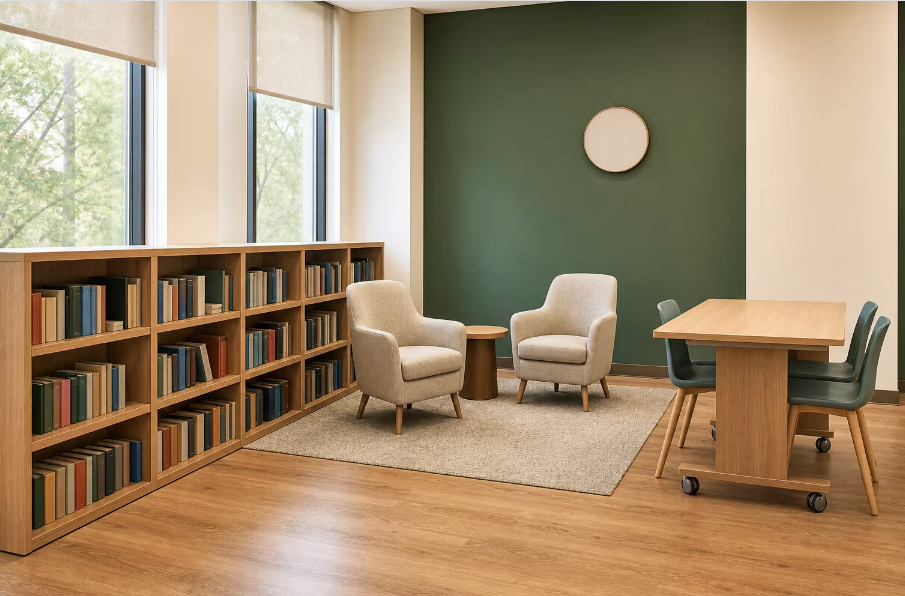
Shelving is the piece most often under-specified. Ask for a load figure per shelf and per bay rather than a general claim of sturdiness, and state how the library intends to use the shelves — heavy reference volumes on a few bays load very differently from evenly spread paperbacks. Shelf thickness, bay depth and the way each bay is connected together all affect how the unit behaves once it is full.
Sightlines matter as much as capacity. Tall shelving run along the walls keeps the middle of the room open, while tall units placed across the room create blind corners that make supervision harder. Low shelving around seating areas keeps the whole reading zone visible from a single position, which is usually what the staff actually want. Aisle widths should allow a wheelchair and a walking student to pass comfortably.
Soft seating fails in schools for two reasons: fabric that cannot be cleaned and foam that collapses. Specify covers that can be removed and laundered, or surfaces that can be wiped, and ask about foam density rather than foam thickness. A low, sturdy base is easier to keep clean than fabric that reaches the floor.
Mobile tables need castors matched to the task. Locking castors stop a table moving while students write, but staff must be able to release them easily. When tables are used for group work and device use, a mix of heights gives the library flexibility to serve both.
Confirm the shelf load rating and the total rating per bay.
Ask for removable or wipe-clean covers on all soft seating.
Check castor type, brake behaviour and load rating on mobile tables.
Give clear aisle widths for wheelchair access.
A library that works usually mixes several zones: a soft reading corner, study tables for group work, individual seats for quiet reading, and a small area for devices. Deciding the zones first makes the furniture list much shorter, because each piece then has a defined job. Planning the list first almost always produces a room that is over-furnished and under-used.
Specify shelf load per bay, not general sturdiness.
Keep tall shelving to the walls to preserve supervision sightlines.
Judge soft seating on cover cleanability and foam density.
Define reading and study zones before writing the furniture list.




Copyright www.hzfgfurniture.com. All Rights Reserved. 浙ICP备2026006019号
