

-
Download
Certificate Query
Certificate Query

 2026/9/11 16:39:25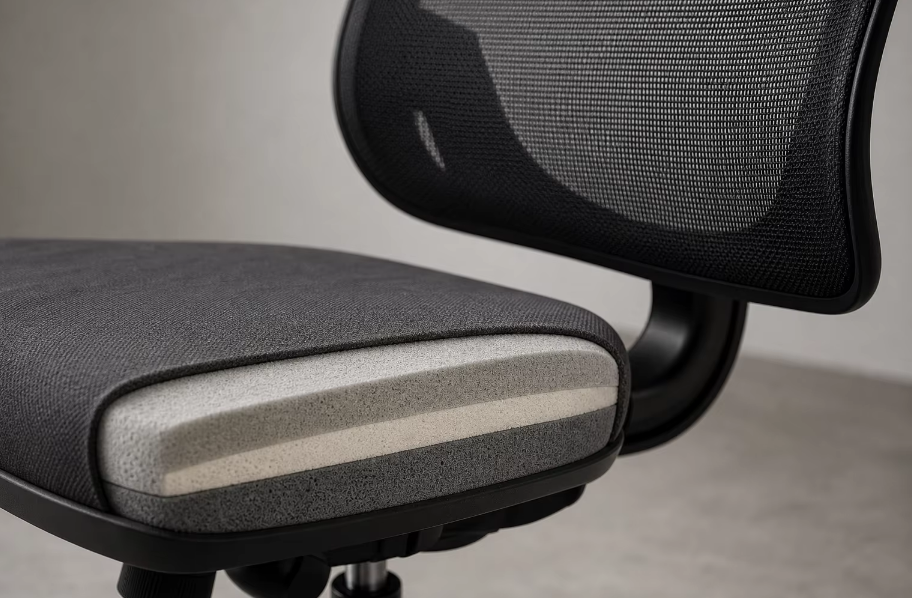
Density and hardness are different measurements, often confused. Density describes how much material is packed into a volume; hardness describes how firmly the cushion pushes back. A dense foam can still feel soft, and a low-density foam can feel firm for the first month before it collapses. Ask suppliers for both values, and treat a specification that lists only hardness as incomplete.
Construction method matters as much as the number. Moulded foam is poured into a shaped tool, so contour, thickness and density stay consistent from unit to unit. Layered foam is cut from blocks and bonded, which allows a softer top and a firmer base but demands tighter control of adhesive and alignment. Neither approach is automatically better; the real question is whether the supplier can repeat the same result across a full container.
Mesh backs are defined by tension and by the frame that holds them. Too little tension and the back pockets under load; too much and the user loses the flex the design intended. Weight ratings should describe the complete chair, not the gas lift alone, because mesh, frame and mechanism share the load. A rating with no stated test basis is a marketing number, not an engineering one.
Breathability works as a system: an open mesh back performs well, yet a hot seat cushion can cancel the benefit, so check airflow through the seat too. Sag rarely appears in a showroom. It shows up months later as softened seat edges, a permanent dip under the regular sitter, or mesh that no longer returns to shape. Ask whether aged or cycling data exists, and describe the performance you need rather than accept a verbal assurance.
Test sample units the way your market will use them. Sit for extended periods rather than seconds and note where pressure builds. Load the front edge of the seat, where weaker foam fails first. Test at your heaviest intended user weight. Leave a sample loaded overnight, inspect recovery in the morning, and compare two batches of the same model.
If a sample survives, the specification deserves the order. If it does not, change it before quantities are locked, because foam and mesh decisions are far cheaper to correct at the sample stage.
Density and hardness are separate values, so ask for both.
Moulded and layered foam suit different contour and cost targets.
Weight ratings must cover the whole chair and cite a test basis.
Test loaded samples before committing to volume.




Copyright www.hzfgfurniture.com. All Rights Reserved. 浙ICP备2026006019号
