

-
Download
Certificate Query
Certificate Query

 2026/9/11 16:35:43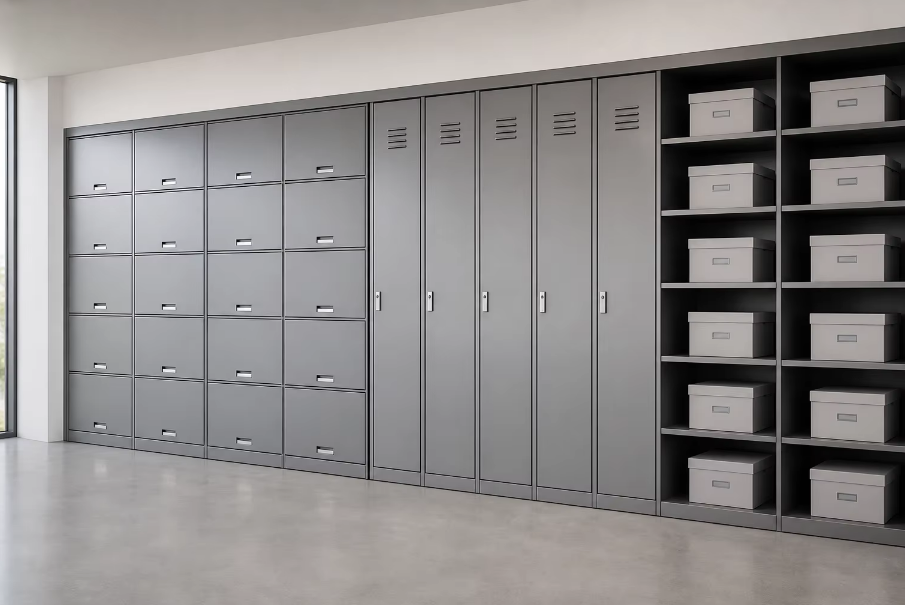
Material choice follows the environment. Steel filing cabinets are the default for document archives and back-of-office zones because they resist wear, accept locks cleanly and stack in tight depths. Melamine cabinets suit front-of-house and open-plan floors where the finish has to match desks and storage walls. Tambour cabinets with retractable doors fit narrow aisles where a hinged door cannot swing.
Coating quality separates suppliers. Ask for the powder-coat thickness and the finish of the cut edges and internal surfaces, not just the visible face, because those are the areas where corrosion appears first. Where storage performance matters, ask a supplier to reference the applicable ANSI/BIFMA X5.5 storage test so quotations can be compared on a like-for-like basis.
Locking is often the deciding specification. Central locking secures all drawers with one key, while individual locks suit shared archives. Master keying, where one key opens many cabinets, is common in facilities contracts; ask the supplier to confirm the keying plan in writing and to state how many keys ship with each cabinet.
Drawer performance should be quoted per drawer rather than per cabinet:
Confirm the runner type and the rated load per drawer
Check whether drawers extend fully or only partially
Agree the keying plan and key quantities before production starts
For filing, the load needed depends on the media stored, and a lateral file holding paper rarely matches the load assumptions of a shallow personal drawer.
Shipping format drives landed cost. Flat-packed cabinets cut freight volume sharply but move assembly labor to the destination, which is only economic where labor is available at a reasonable cost relative to sea freight. Assembled cabinets arrive ready to place but consume far more container volume for the same unit count.
Before choosing, confirm the assembled weight, the number of cartons per cabinet and whether the customer has the tools and labor for flat-pack assembly. Keep assembly instructions and a parts list in the destination language, and confirm that fasteners are included and replaceable.
Match the body material to the zone, and check coating and edge finish, not just the visible face.
Agree the keying plan and key quantities in writing before production.
Quote drawer load and runner type per drawer, not per cabinet.
Compare flat-pack and assembled options on landed cost, including assembly labor.




Copyright www.hzfgfurniture.com. All Rights Reserved. 浙ICP备2026006019号
