

-
Download
Certificate Query
Certificate Query

 2026/9/11 16:11:29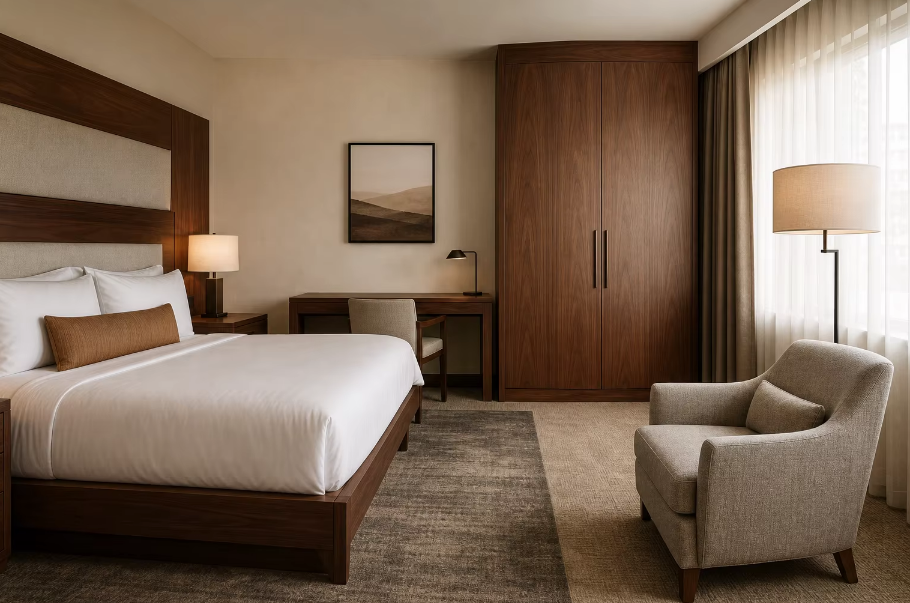
In hotel FF&E language, casegoods are the rigid pieces: nightstands, desks, dressers, wardrobes, headboard panels, credenzas and luggage benches. They are usually built from veneer, laminate or solid timber over a manufactured board core, with metal hardware and drawer runners. Upholstered furniture covers everything whose comfort comes from cushioning: armchairs, sofas, dining chairs, lounge seating and ottomans.
The split matters because the two are engineered differently. Casegoods are judged on joinery, edge detailing, hardware life cycles and finish consistency. Upholstered items are judged on frame construction, foam density and resilience, suspension and fabric performance. A spec sheet that treats them as one line item will leave gaps at inspection.
Upholstered seating generally carries the higher MOQ per model, because each silhouette needs its own frame jigs, foam cutting and pattern templates. Casegoods MOQs are lower per unit but often higher per finish, since a new veneer or lacquer run has its own setup cost.
Lead times follow the same logic. Casegoods with an approved finish and standard dimensions move faster; upholstered pieces sit behind fabric lead times, which is where many schedules slip. Lock hardware early too — drawer runners, handles and levelling glides are frequently the last items confirmed and the first to delay an installation.
Which to lock first? Approve the upholstery fabric and the wood finish before releasing either category, then confirm casegoods first so the room's fixed geometry is set. Upholstered items can absorb small dimensional changes; wardrobes and desktops cannot.
Finishes should be drawn from one shared palette so that timber tones, metal trims and lacquer sheen read as a single scheme rather than a set of separate purchases. Ask for physical samples under the same lighting rather than relying on screen renders.
Packing and container mix are commercial, not technical, decisions:
Casegoods travel flat-packed or knock-down, which loads denser and lowers freight per cubic metre.
Upholstered seating ships assembled or semi-assembled, so it consumes volume and needs corner protection.
Mixed containers should be planned so upholstery fills the top and voids, not the floor footprint.
Carton labelling, stacking limits and moisture protection should be agreed before production starts.
Casegoods are rigid millwork; upholstered furniture is cushion-led seating, and the two are inspected differently.
Upholstered models usually carry higher MOQs and longer lead times because of frame tooling and fabric supply.
Approve the shared finish palette first, then lock casegoods before seating so room geometry is fixed.
Packing method changes freight economics — flat-packed casegoods load denser than assembled seating.




Copyright www.hzfgfurniture.com. All Rights Reserved. 浙ICP备2026006019号
