

-
Download
Certificate Query
Certificate Query

 2026/9/11 15:30:48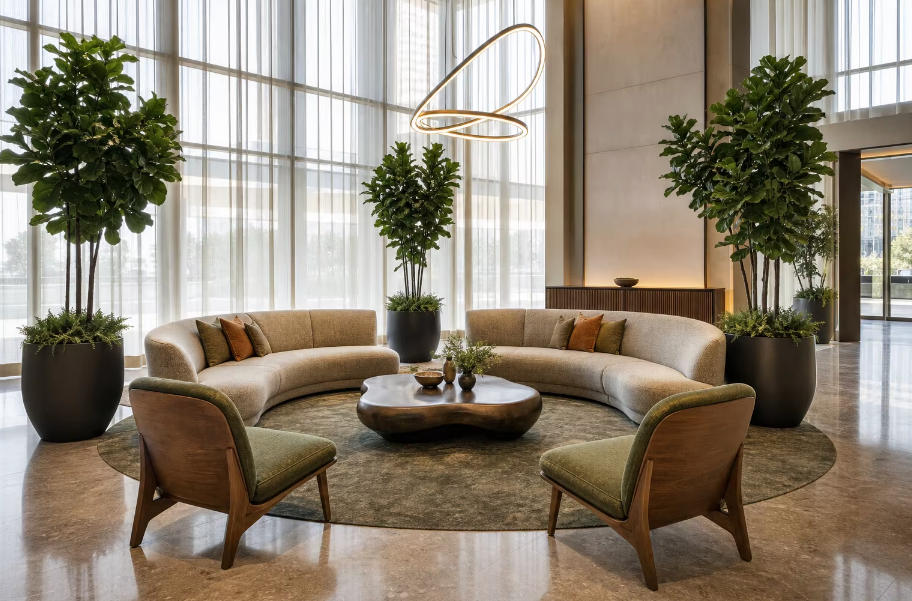
Design trends reach the FF&E package through a delay: a direction that appears in concept schemes this season is specified and manufactured the next, so buyers often commit budget before it has been proven in service. Each direction is treated here as two things at once — a design move and a specification decision — because the second determines whether the furniture still looks right after a few years.
Guest rooms are moving toward domestic comfort: softer silhouettes, layered textiles, warmer wood tones, and arrangements that read as a living space rather than a hotel room.
What it means for your next FF&E order: residential styling conflicts with commercial duty cycles. Keep the softer look but specify higher-density, higher-resilience foam, commercial-grade upholstery, and a fabric cleanability statement matched to your housekeeping chemistry. Because freestanding casegoods get moved, specify moisture-resistant cores and finished backs.
Bouclé, performance velvet, cane and rattan detailing, fluted and reeded wood, and textured plaster finishes are all entering hospitality specifications. They read as warm and handcrafted — and the trade-off is maintenance. Looped fabrics can snag and trap soil, velvet shows seating marks and shading, and woven elements collect dust.
| Material | Visual effect | Maintenance trade-off | Where it works best |
|---|---|---|---|
| Bouclé | Soft, tactile, residential warmth | Loop texture snags; shows soil in high-contact areas | Guest room accent chairs, headboards |
| Performance velvet | Depth and color richness | Seating marks and pile shading | Lounges, headboards, low-turnover seating |
| Cane / rattan detailing | Natural, airy, resort character | Open weave traps dust | Headboards, cabinet fronts, terraces |
| Fluted / reeded wood | Rhythm and shadow without pattern | Crevices need dusting; damage is hard to touch up | Casegoods fronts, lobby millwork |
| Textured plaster look | Soft, matte, hand-applied character | Less cleanable than sealed surfaces | Feature walls, low-contact areas |
What it means for your next FF&E order: match the material to the zone, not to the mood board. Keep tactile materials in guest rooms and low-turnover areas, and use smoother, more cleanable surfaces where food and beverage are served.
Curved sofas, rounded casegoods, pill-shaped ottomans, and organic table shapes continue to replace hard-edged geometry.
What it means for your next FF&E order: curves cost more to build and to ship. Rounded and curved frames need more internal structure and careful upholstery work, and they pack less efficiently. Confirm the upholstery method and seam placement at sampling stage, and plan freight from the packed footprint, not the nominal dimensions.
Lobbies are being planned as hybrids — check-in, café, co-working, and social space in one volume. That drives demand for reconfigurable modular sofas, movable tables and stools, mixed lounge and high-top seating in one zone, and integrated power access.
What it means for your next FF&E order: specify connection systems and movable pieces for repeated reconfiguration, and check that every seating type has a plausible cleaning method for beverage spills, and confirm that individual modules and covers can be reordered later.
Indoor greenery, natural materials, and a push toward usable terraces and rooftop spaces are shaping selection and layout; outdoor lounges are increasingly specified to the same design standard as interiors.
What it means for your next FF&E order: outdoor furniture lives in a different material world. Specify frames finished for UV and corrosion resistance, quick-drying and mold-resistant foam, solution-dyed outdoor fabrics with lightfastness and water repellency, and hardware that will not rust in coastal air. Confirm how cushions drain and dry, and check that covers are removable. Indoor-rated rattan and untreated timber will fail outdoors — verify the rating, not the look.




Copyright www.hzfgfurniture.com. All Rights Reserved. 浙ICP备2026006019号
