

-
Download
Certificate Query
Certificate Query
 2026/9/4 17:11:42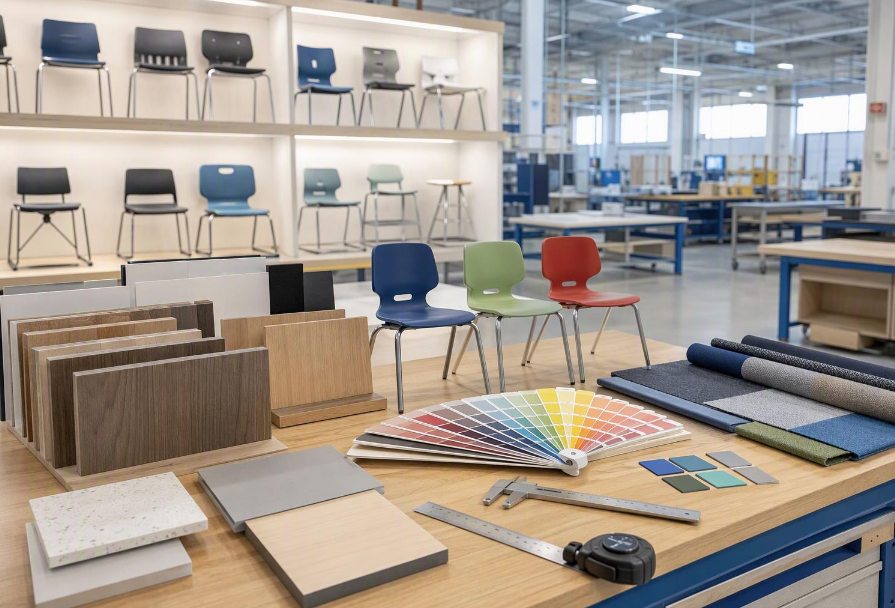
OEM (Original Equipment Manufacturing). You supply the specification — designs, materials, dimensions — and the factory produces your product under your brand. You control the design; the factory controls production.
ODM (Original Design Manufacturing). The factory develops and offers the design, and you customize it — colors, branding, minor spec changes — before selling it under your brand. Faster and usually cheaper, with less design work on your side.
Many importers start with ODM and move toward OEM as their market teaches them what sells.
Colors and finishes. Match your brand palette or a local design trend.
Sizing. Adapt dimensions to local student body sizes and classroom standards.
Branding. Logo printing or molding on chairs, desks and packaging builds brand recognition in your market.
Materials and features. Upgrade tabletops, add castors, change frame colors or specify different plastics.
Compliance. Adapt products to the safety and quality requirements of your destination market.
A typical custom program follows clear stages:
Brief and quotation. Share your target product, quantities and customizations. The factory proposes specifications, tooling costs (if any) and unit pricing.
Sampling. Pre-production samples confirm look, dimensions and function. Expect one to three sample rounds for complex changes.
Testing and approval. Verify samples against your requirements, arrange any compliance testing, and approve in writing.
Bulk production. Agree on lead time, quality checkpoints and inspection arrangements before production starts.
Pre-shipment inspection and delivery. Third-party or factory inspection, then packaging and shipment per your instructions.
Define MOQ realistically. Minimum order quantities depend on production efficiency — a realistic MOQ protects both sides. Discuss how customization affects MOQ before you fall in love with a design.
Protect your design. If exclusivity matters, agree on it in writing; a reputable factory keeps your tooling and designs confidential.
Lock specifications. Document colors, dimensions and materials in a written specification sheet — changes mid-production are expensive.
Plan for repeatability. Ask how the factory manages color consistency across batches so your year-two orders match your year-one orders.
Keep samples as the reference. The approved sample is the standard every future order is judged against.
A custom school furniture program turns a commodity purchase into a product line only you can sell. Our factory supports OEM and ODM projects — from color changes to fully branded ranges — with samples, documentation and export experience. Contact us to start your program.




Copyright www.hzfgfurniture.com. All Rights Reserved. 浙ICP备2026006019号
