

-
Download
Certificate Query
Certificate Query

 2026/10/27 15:12:28
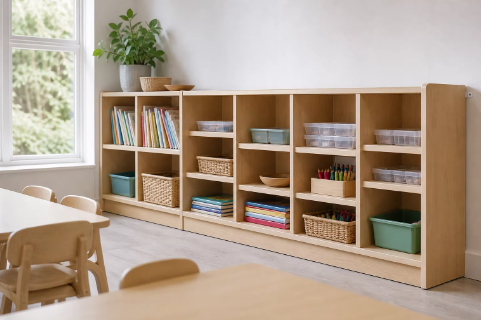
The classroom storage cubby is open tray shelving at child height, built to hold books, art materials and daily equipment within reach. It solves a practical problem: keeping a busy primary room ordered without locks, keys or the traffic of a corridor locker bank.
Where a corridor locker serves security, the cubby serves access. It stands inside the teaching space, against a wall or at the edge of a group table, and children reach into it many times a day without asking for a key. That frequency changes the brief. Compartments must be obvious at a glance and deep enough for a book or a tray. The unit also reads as furniture rather than equipment, so its proportions and finish should sit quietly beside desks and chairs.
Most units are a grid of open compartments rather than one shelf run, because mixed sizes let a bay take picture books, another shallow trays and a third art supplies. The carcass is usually board-based, joined with dowels or cam fittings and braced by a solid back panel that stops the frame racking when a child leans on it. A plinth lifts the base away from cleaning water; castors trade that protection for mobility. Trays slide into the openings, edges are rounded or lipped, and wall brackets anchor the top.
Start with what goes in: measure the tallest book, widest tray and deepest box of art materials, then choose a compartment pattern that takes all three. Decide whether the unit stands against a wall or runs perpendicular to it as a low room divider; a divider needs a finished back and a stable base. Mobility suits shared rooms, but castors raise the working height and need brakes. Check edge radius, finger-trap gaps and wall fixing. On a sample, load a shelf and push the frame sideways.
At a glance:
Open compartments at child height, no keys needed
Mixed bay sizes for books, trays and materials
Rounded edges, braced back and wall fixing




Copyright www.hzfgfurniture.com. All Rights Reserved. 浙ICP备2026006019号
