

-
Download
Certificate Query
Certificate Query

 2026/10/27 14:55:36
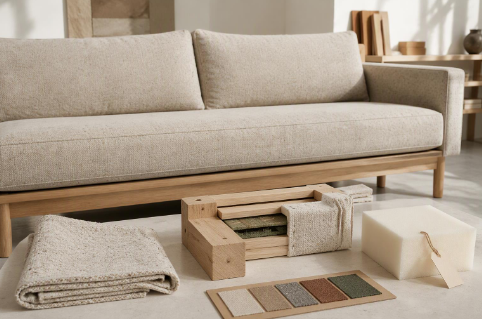
Retailers and importers are being asked harder questions about furniture: where the timber comes from, what the fabric contains, whether the product can be repaired and what happens when it is thrown out. Buyers in Europe and North America increasingly need answers for tenders, marketplaces and their own sustainability reporting.
A sofa that is genuinely more sustainable is rarely built from a single "green" material. It is a series of decisions that reduce impact without compromising durability — because the most sustainable sofa is usually the one that lasts longest.
Certified timber — FSC or equivalent chain-of-custody certification is the clearest way to show responsible sourcing. Ask for certificate numbers and the scope that covers your product.
Engineered wood — plywood and OSB use fibre efficiently and can be more stable than solid timber, provided the resin system meets emissions requirements.
Recycled or recyclable metals — steel in mechanisms and legs is highly recyclable and often already contains recycled content.
Joinery that can be repaired — screwed and bolted construction is easier to disassemble and repair than glued-only frames. This matters at end of life.
Foam is often the largest volume of a sofa's non-textile material and is difficult to recycle in many markets.
Ask about foam with recycled content and whether offcuts are reused in production.
Specify foam that will not collapse prematurely; durability is a sustainability benefit.
Consider whether the cushion core can be replaced independently of the cover.
Recycled polyester made from post-consumer bottles is now widely available and performs much like virgin polyester. Ask for the percentage of recycled content.
Natural fibres such as linen, wool and cotton have different end-of-life and care profiles; they are not automatically better, especially where durability is poor.
Solution-dyed fabrics use less water in dyeing and resist fading, which extends life.
PFAS-free finishes are increasingly requested; confirm what stain protection is used.
Durability testing — a fabric that wears through in three years is not sustainable regardless of its content.
Modular construction lets worn sections be replaced instead of the whole sofa.
Removable covers extend life and allow reupholstery.
Standard fasteners and accessible components make repair practical.
Disassembly instructions help recyclers separate foam, fabric, timber and metal.
Take-back or refurbishment programmes, where offered, are a genuine differentiator.
Frame material, certification and chain of custody.
Foam type, recycled content and expected service life.
Fabric composition, recycled content, durability and finish chemistry.
Availability of replacement covers, cushions and legs.
End-of-life guidance and any take-back option.
Documentation that supports your own reporting, not just a marketing statement.
Sustainability in sofas is less about a single certificate and more about durability, repairability and honest documentation. Buyers who ask precise questions get products that survive both use and scrutiny.




Copyright www.hzfgfurniture.com. All Rights Reserved. 浙ICP备2026006019号
