

-
Download
Certificate Query
Certificate Query

 2026/10/27 14:47:06
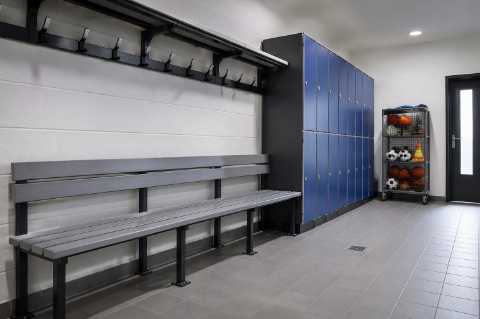
A school sports hall hosts PE lessons, after-school clubs, exams, assemblies and community lettings, often on the same day. Changing rooms take the brunt of it: wet boots, showers, mud and dozens of students moving through in a few minutes.
Furniture in these areas is rarely specified with the same care as classroom furniture, and it shows within a year — benches that rock, storage that jams, seating that peels.
Bench seating should be robust enough for bags, boots and students standing on them. Look for a stable frame, a slatted or perforated seat that drains and ventilates, and wall or floor fixings suited to the substrate.
Height and depth matter: benches that are too narrow are uncomfortable and get damaged; benches with no back support are tiring for younger students.
Hooks and shelving above benches keep bags off the floor and reduce clutter. Specify heavy-duty hooks with rounded ends.
Wet zones need non-absorbent materials; timber-look laminates and coated steel are easier to maintain than natural timber in constant humidity.
Privacy and supervision — layout should allow staff sightlines while giving students some modesty. Bench islands are often easier to supervise than closed cubicles.
Spectator seating for parents and students can be stacking chairs, bench seating or retractable units where space allows. Whatever the choice, it must store compactly and move easily.
Equipment storage is the most under-planned item. Specify shelving, ball trolleys and lockable cupboards sized for the equipment the school actually owns, not a catalogue average.
Score tables and officials' furniture should be simple, stable and easy to move.
Floor protection — trolleys and stacking chairs need non-marking castors suitable for timber or synthetic sports floors.
Powder-coated steel frames resist knocks and moisture far better than painted finishes.
Solid plastic or compact laminate seats are easier to clean than upholstered benches in wet areas.
Stainless steel or coated hardware resists corrosion in shower-adjacent zones.
Avoid exposed particle board edges, which swell quickly when wet.
Specify replaceable feet, glides and castors; these are the first parts to fail.
Check fixing methods against the wall and floor build-up; a bench that pulls out of lightweight blockwork is a serious risk.
Confirm slip resistance and drainage around bench areas.
Ensure storage does not obstruct escape routes or emergency equipment.
Allow for ventilation and drying; damp kit left in closed cupboards becomes a smell and mould problem.
Agree a maintenance routine for hinges, locks and castors, since sports furniture is used far more intensively than classroom furniture.
Sports facilities are judged by parents on match days and by staff every working day. Specifying for moisture, impact and heavy traffic costs little more at purchase and saves a great deal in replacement.




Copyright www.hzfgfurniture.com. All Rights Reserved. 浙ICP备2026006019号
