

-
Download
Certificate Query
Certificate Query

 2026/10/23 14:28:27
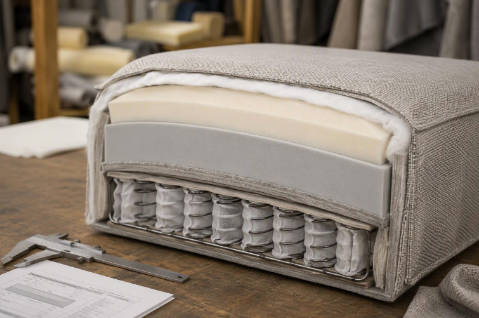
Shoppers judge a sofa by sitting on it for three minutes in a showroom. Retailers and importers have to judge it over years of daily use. That gap is why cushion specification matters so much: it determines the initial feel, the support, the recovery and how the sofa looks after a year of family life.
Foam is also where the largest quality differences hide, because fillings are rarely visible and easy to reduce when a price needs to come down.
Standard polyurethane foam — inexpensive and widely used. Comfortable at first, but lower-density grades soften and collapse relatively quickly.
High-resilience (HR) foam — denser and more elastic, with better recovery. It is the practical baseline for a sofa expected to last.
Memory foam — pressure-relieving and slow to recover. Often used as a top layer over HR foam rather than throughout, since it can feel warm and slow.
Pocket springs — individually wrapped coils under foam or fibre, giving support and a more upholstered feel. Common in higher-tier seats.
Fibre and feather — soft, inviting and requiring regular plucking. Feather cushions need a feather-proof lining and a compatible fill ratio to hold shape.
Latex and other niche fills — durable and responsive, but heavier and more expensive.
Many good cushions combine layers: a supportive core, a comfort layer and a fibre wrap to soften the feel and reduce wear on the cover.
Density is weight per volume, usually expressed in kilograms per cubic metre. Higher density generally means more material, better support and slower loss of resilience — but density alone is not comfort.
A dense foam can still be hard or poorly formulated.
A softer foam can be comfortable but unsuitable for a seat that gets heavy daily use.
Two foams with the same density can behave differently depending on formulation and cell structure.
Ask suppliers for the density and the type of foam (standard, HR, memory), not just a grade name. Where possible, request a sample or a pre-production cushion to test.
Entry level — standard foam in seat and back, with a fibre wrap. Acceptable for occasional use; expect softening within a few years.
Mid range — HR foam core, fibre-wrapped, with pocket springs in the seat for better support. This is where most durable retail sofas sit.
Premium — higher-density HR foam, pocket springs, layered comfort materials and feather or fibre toppers, with a defined foam warranty.
Consistency matters as much as specification: a model should feel the same in every production batch. Put the foam type and density in the specification, and inspect a sample from each order.
Sit for at least ten minutes, not ten seconds, and test the seat edge where people perch.
Ask how the cushion is constructed, not only what it contains.
Confirm whether cushion covers are removable and whether replacement cores are available.
Check the warranty terms for foam specifically — many exclusions relate to normal softening.
Review the packaging, since compressed foam can take time to recover after shipping.
For importers, foam specification is one of the clearest ways to distinguish a product that will generate returns from one that will generate repeat orders.




Copyright www.hzfgfurniture.com. All Rights Reserved. 浙ICP备2026006019号
