

-
Download
Certificate Query
Certificate Query

 2026/10/21 15:40:33
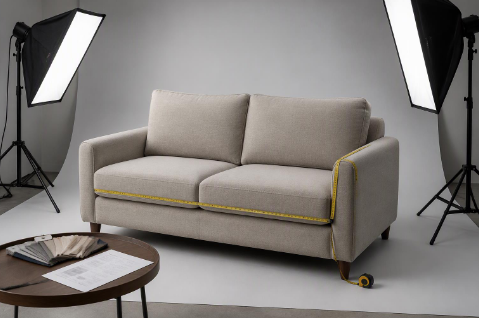
Retailers increasingly buy sofas they will never see in a showroom. The decision is made from a web page: images, dimensions, fabric options, delivery information and care instructions. If a supplier cannot provide that content, the retailer has to create it — or leave the product out of the range.
For importers and suppliers, product content has become a competitive advantage. It shortens onboarding, reduces returns and helps a retailer sell the same sofa at a better margin.
A complete product data set is more than a price list. For each sofa model, retailers need:
Dimensions — overall width, depth, height, seat height, seat depth, arm height, and the dimensions of the carton. State whether measurements include cushions.
Configuration — modules included, left- or right-hand chaise, whether sections can be separated and reconnected.
Materials — frame construction, suspension type, foam specification, leg material and finish.
Fabric options — composition, abrasion data, cleaning code, available colours and whether the fabric is stocked or made to order.
Weights and volumes — product weight and packed volume per unit, which drive delivery pricing.
Assembly and delivery — whether the sofa arrives assembled or flat-packed, minimum door width, and what tools are required.
Care and compliance — care instructions and the documentation required in the destination market.
A single structured spreadsheet per collection, kept up to date, saves months of repeated questions. Suppliers who provide it are usually the first to be reordered from.
Retail photography has to do more than look attractive. A useful set includes:
Clean cut-out images on white or transparent background for listings and marketplaces.
Lifestyle shots showing scale in a real room, ideally with a person or familiar object for reference.
Detail images of stitching, fabric texture, legs, cushion construction and any mechanism.
Configuration images showing the sofa as a straight unit, as a corner, and with the chaise reversed.
Colour-accurate swatch images photographed under consistent lighting, with the colour name and code.
Short video or GIF of a recliner or sleeper mechanism in use.
Consistency matters as much as quality: the same angle, lighting and background across a collection let a retailer build a coherent category page instead of a patchwork of images.
Content is often promised verbally and delivered late. Put it in the order:
List the required image types and minimum resolution in the supplier agreement.
Require raw files or high-resolution originals, not screenshots from a catalogue.
Agree a deadline before the first shipment, and make final payment or repeat orders conditional on delivery.
Ask for the right to use the images in retail, marketplaces and paid advertising.
Confirm that any 3D or rendered images are labelled as renders.
Better content reduces returns caused by size and colour surprises, shortens the time from container arrival to listing, and allows a retailer to sell through multiple channels with one asset set. For the supplier, it is a low-cost differentiator that is hard for competitors to copy quickly.
A sofa is a considered purchase. The retailer's page is where most of that consideration happens — and the supplier who supplies the page, not just the product, becomes the easier partner to keep.




Copyright www.hzfgfurniture.com. All Rights Reserved. 浙ICP备2026006019号
