

-
Download
Certificate Query
Certificate Query

 2026/10/21 15:39:05
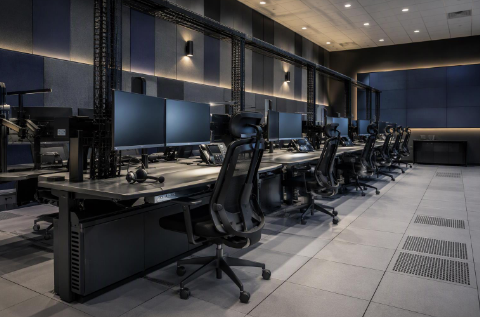
Most office furniture is specified for a person who sits for part of the day, moves between meetings and leaves at six. Control rooms and call centres are different: seats are occupied continuously, often across three shifts, with multiple screens, headsets and very little movement.
That changes the specification in four areas — seating, desks, cable management and acoustics — and makes durability a financial question rather than a comfort preference.
In a 24-hour operation, a chair may be used for close to twenty hours a day. Weak components fail quickly, and a failed chair removes an operator from a console.
Prioritise mechanism quality and foam density over styling. A cheap gas lift or a collapsed seat cushion becomes a staffing problem.
Specify adjustable seat height, seat depth and lumbar support, because one chair will be shared by different body types across shifts.
Choose a headset-friendly back and arms that do not clash with desk edges.
Confirm spare-part availability for castors, gas lifts and arm pads; these are replaced long before the chair is.
Consider a small pool of chairs for immediate swap-out rather than waiting for repairs.
Operators often work with two to four monitors, a phone or headset, and reference material. Desks must accommodate that without becoming a cable trap.
Check desk depth and width against the actual monitor layout, not a generic 120 cm assumption.
Provide cable trays, vertical risers and power modules so cables do not run across the floor.
Consider height-adjustable desks where staff stand for part of a shift; stability at standing height matters more than speed of adjustment.
Allow for under-desk clearance for legs and any CPU or equipment housing.
Specify scratch-resistant, easy-clean work surfaces; shared consoles show wear quickly.
Call centres and control rooms combine continuous speech, alerts and equipment noise. Furniture can help or hurt.
Use acoustic panels and screens to break up large open floors.
Choose upholstered or felt-backed partitions rather than hard surfaces where speech privacy matters.
Plan quiet rooms or pods for escalated calls and supervisor conversations.
Keep hard storage away from operator positions; doors and drawers generate noise all day.
A 24/7 environment never gets a full weekend to recover. Specify for continuous cleaning and rapid turnover:
Wipe-clean surfaces and non-porous upholstery that tolerate commercial cleaning agents.
Robust edge banding on desks; operator positions take constant contact.
Floor-friendly castors and glides; chairs move between consoles frequently.
Clear numbering or labelling of workstations so equipment and furniture stay matched after cleaning or maintenance.
Ask suppliers for component-level details, not just finished-product photos: mechanism type, foam specification, gas-lift class, cable management capacity and warranty terms by component. Request a sample chair for a two-week trial on a live shift, and test it with the people who will sit in it for eight hours.
In these environments, furniture is operational equipment. Specifying it that way reduces downtime, protects staff and delays the next replacement cycle.




Copyright www.hzfgfurniture.com. All Rights Reserved. 浙ICP备2026006019号
