

-
Download
Certificate Query
Certificate Query

 2026/9/11 15:26:58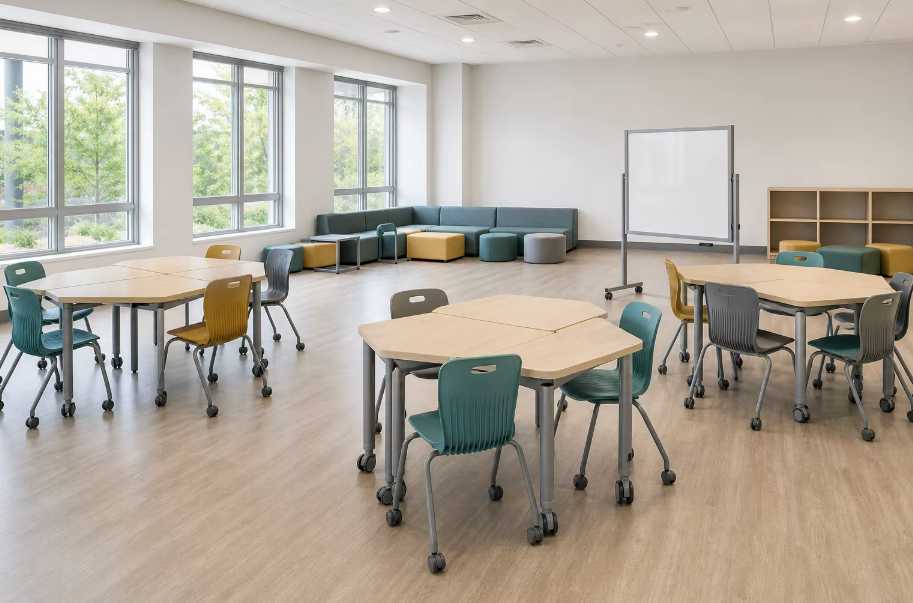
The direction of travel is consistent across most education markets, even where budgets and regulations differ. Schools are moving from furnishing classrooms with one fixed desk and one fixed chair per student toward furnishing spaces that can change shape during the day. That shift changes what buyers are asked for: not a catalogue of single products, but a system of compatible parts that can be rearranged, stacked, nested and moved.
For importers and distributors, this is a commercial opportunity and a specification burden at the same time. A flexible-learning range is harder to buy than a fixed-height desk, because the buyer has to understand how the pieces work together, not just how each piece looks on its own.
The clearest and most durable trend is the move to furniture that can be reconfigured rather than replaced.
Casters let tables and seating move between a lecture layout and a group layout without staff lifting anything.
Nesting desks collapse or slide together to free up floor space outside lesson time.
Stackable chairs reduce storage footprint and make room turnaround practical.
Mobile whiteboards and dividers allow a single room to become two zones, or a corridor to become a teaching space.
The practical question for a buyer is whether the whole set shares a coherent geometry. Casters that are individually good but in three different heights, or nesting desks from two different families, will frustrate the school faster than a simpler single-system order.
Procurement briefs increasingly describe a mix of seating types in the same room: standard desks and chairs for focused work, soft seating and bean bags for reading, and standing-height options for short-burst activities. The intent is to let students choose a posture that suits the task, not to replace desks entirely.
This matters for order planning. Mixed seating means the order is no longer a simple multiple of the class roll; it is a ratio. Buyers should get the ratio from the school or project specifier rather than assuming it, since the right mix depends on pedagogy, room size and age group.
Ergonomics has moved from an optional upgrade to a line item on the specification. Buyers are now asked to demonstrate that seat height matches student stature, that back support exists, and that the furniture is comfortable for a full school day rather than for a photograph.
The recognized reference for this remains EN 1729 for educational furniture. EN 1729-1 provides the size-mark system that links furniture to student stature ranges, and EN 1729-2 covers safety requirements and test methods. Following the size-mark approach is more reliable than choosing furniture by age label alone, because stature varies widely within any single grade.
Adjustable seating is the other half of the ergonomics story. It costs more and adds a mechanism that can be damaged, so it makes sense where student sizes vary within one room, where furniture will be redeployed across grades, or where the buyer's market expects adjustment as standard. In other markets, fixed-height furniture specified by size mark is the more efficient answer.
School furniture is high-frequency, low-gentleness use. The trends here are unglamorous but decisive:
Thicker powder coating and better weld quality on steel frames.
Impact-resistant seat shells rather than thin, brittle moldings.
Edge banding that stays bonded under daily abrasion and cleaning.
Surfaces that tolerate repeated wiping with common school cleaning agents.
Simple mechanisms with few parts, because complexity is where damage starts.
For a buyer, this translates into the documents worth requesting: coating specification, tube wall thickness, the board used under each laminate, and a real answer about how the product behaves when it is cleaned every day for years.




Copyright www.hzfgfurniture.com. All Rights Reserved. 浙ICP备2026006019号
