

-
Download
Certificate Query
Certificate Query

 2026/9/4 16:18:00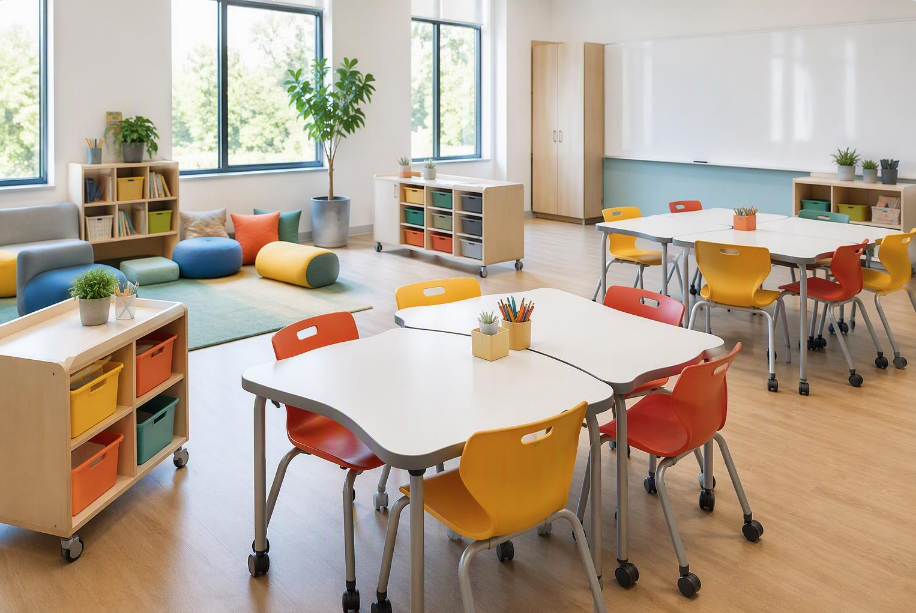
The single most important shift in classroom design is the move from one-purpose rooms to multi-zone learning spaces. Instead of a uniform layout, modern classrooms are divided into flexible zones that support different activities:
Direct instruction — a front area where the whole class gathers briefly for teacher-led input.
Collaboration — cluster desks or tables where groups of three to six students work together.
Independent focus — individual workstations, carrels or quiet nooks for solo tasks and assessment.
Breakout and soft zones — reading corners and lounge seating that give students a change of posture and energy.
The key word is reconfigurable. Teachers rarely keep the same layout all day. A classroom that can be rearranged in under five minutes lets educators match the space to the lesson instead of the other way around.
Flexibility is not a single product — it is a system of pieces that work together. The most effective flexible classrooms combine:
Mobile desks and tables. Desks on locking casters that can be grouped into quads, pushed into rows for tests, or cleared away for presentations. Look for models that nest or fold to maximize storage when not in use.
Lightweight, nestable chairs. Chairs that stack or nest in a compact footprint make rapid reconfiguration practical for teachers of all ages and strengths.
Agile seating options. Rocker chairs, wobble stools, standing-height tables and soft seating give students movement-friendly choices beyond the standard chair.
Writable surfaces. Whiteboard-top tables and writable marker boards on casters turn any group space into an idea-sharing surface.
Storage on wheels. Mobile trolleys and cabinets keep materials close to each zone and disappear when the room needs to be open.
When technology is part of the lesson, desks with cable-management trays and built-in power access keep devices charged without a tangle of extension cords across the floor.
Flexibility adds moving parts, and moving parts need to be built for school life. When sourcing flexible classroom furniture, focus on:
Mobility hardware. Heavy-duty casters with brakes that lock firmly for safety during instruction.
Stacking and nesting efficiency. Compact storage means fewer storage rooms and easier room turnovers.
Student-proof construction. Impact-resistant edges, rounded corners and surfaces that wipe clean after marker, paint and lunch.
Healthy materials. Low-emission finishes and furniture that complies with classroom safety standards in your market.
Serviceability. Replaceable casters, tops and seats extend useful life and reduce long-term replacement costs.
Buying direct from a specialized school furniture manufacturer gives you more control over colorways, sizing, branding and packaging — and one accountable partner for samples, documentation and container logistics.
Whether you are furnishing a new campus, renovating an aging school or supplying distributors in overseas markets, flexible classroom furniture is one of the highest-impact investments you can make in how students learn. Our team designs and manufactures school furniture for projects worldwide — contact us for catalogs, samples and quotations.




Copyright www.hzfgfurniture.com. All Rights Reserved. 浙ICP备2026006019号
