

-
Download
Certificate Query
Certificate Query

 2026/11/6 17:07:39
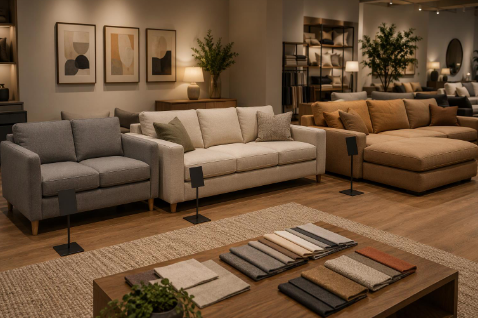
A retailer's sofa range is a set of decisions about price, specification and display. Too narrow and customers leave; too broad and stock, floor space and staff knowledge all suffer.
Good-better-best is not a slogan. It is a way to make the trade-up obvious and to keep each tier profitable.
Customers pay more when they can see and feel a difference. Decide which variables move between tiers, and keep them consistent across the range.
Frame and construction: particle board versus plywood versus hardwood; screwed versus dowelled and blocked joints.
Suspension: webbing, sinuous springs or pocket springs.
Seat fill: standard foam, high-resilience foam, or foam with a spring or feather wrap.
Fabric: basic polyester, performance weave, or premium wool or leather.
Details: removable covers, solid timber legs, deeper seating, modular connectors.
Service: warranty length, delivery, assembly, and cover replacement.
If the difference is invisible on the shop floor, the customer will simply buy the cheapest.
Good. Entry price, proven frame, basic fabric, two or three best-selling sizes. Its job is to get the customer into the category.
Better. The volume driver. Better suspension, high-resilience foam, performance fabric, wider size and configuration choice.
Best. The image piece. Premium materials, deeper comfort, stronger warranty, exclusive fabrics. Sells in smaller volume but lifts the perceived value of the whole range.
Keep the step between tiers meaningful but not confusing: three clear price points are easier to sell than seven overlapping ones.
Limit sizes per model: a small space, standard and larger configuration often cover most demand.
Limit fabrics on the floor to a curated set, with the full book available to order.
Standardise legs, connectors and cushion specifications so parts can be shared.
Review slow sellers quarterly and replace rather than accumulate.
Place the three tiers in the same sightline so comparison is easy.
Use cutaway samples or cushion cross-sections to show hidden differences.
Label the benefit, not the material: "stays firm for years" rather than "35 density foam".
Train staff to ask three questions — room size, users, cleaning habits — then recommend a tier.
Confirm margin by tier, not just on average.
Check stock turn and lead times for each tier.
Plan spare covers for the best-selling fabrics.
Keep entry-tier quality above the level that generates returns.
Agree exclusive fabrics or sizes to avoid direct price comparison.
A clear good-better-best range gives customers a reason to trade up and gives the retailer a story to tell. Build the ladder around visible differences, keep the SKU count disciplined, and the range will sell across price points instead of competing with itself.




Copyright www.hzfgfurniture.com. All Rights Reserved. 浙ICP备2026006019号
