

-
Download
Certificate Query
Certificate Query
 2026/10/23 14:05:44
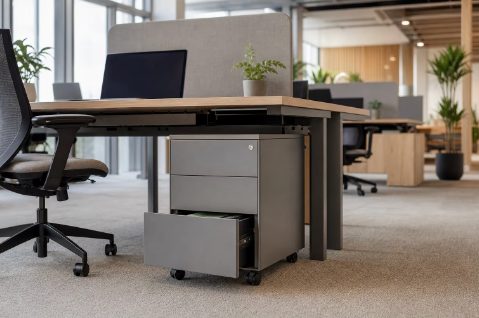
The mobile pedestal is the personal storage unit that makes shared desks work. It rolls to a booked workstation, takes a bag, laptop and papers out of sight, and locks them there. For hot-desking and bench desking, it turns an open desk into somewhere a person can leave their things.
The pedestal sits between the desk and the locker, and its value depends on that position. Under-desk storage keeps a workstation usable by whoever books it next, while the unit still belongs to one person for the day. The design logic is mobility plus privacy: casters so it can be taken to a meeting or pushed aside for legroom, and a lock so personal items stay private. Some designs add a cushioned top so the unit doubles as an informal perch.
Drawer configuration sets the working pattern: shallow personal drawers, a deeper file drawer, or a combination in one bank. Runner type decides how drawers behave under load; roller runners are the baseline, ball-bearing runners carry more with less play, and full-extension runners reach the back of a deep drawer. Locking covers the whole bank, with master-key options for facilities teams. Casters should suit hard and soft floors and carry brakes. Steel carcasses resist impact, board carcasses match desk finishes, and edge banding quality shows at the corners.
Match pedestal height to the desk and check clearance for the top surface, pulls and casters before committing. A unit that fouls a monitor arm or a chair is a return, not a detail. Count pedestals against headcount and policy: one per assigned seat, fewer where lockers take the overflow, and a shared bank where teams hot-desk. Decide who holds master keys. On a sample, open every drawer fully under load, roll the unit across hard floor and carpet edge, and check that the lock still engages.
At a glance:
Rolls under the desk, locks, and may seat a visitor
Runner and interlock quality decide daily behavior
Height and clearance must match the desk


Copyright www.hzfgfurniture.com. All Rights Reserved. 浙ICP备2026006019号
