

-
Download
Certificate Query
Certificate Query

 2026/9/16 14:32:06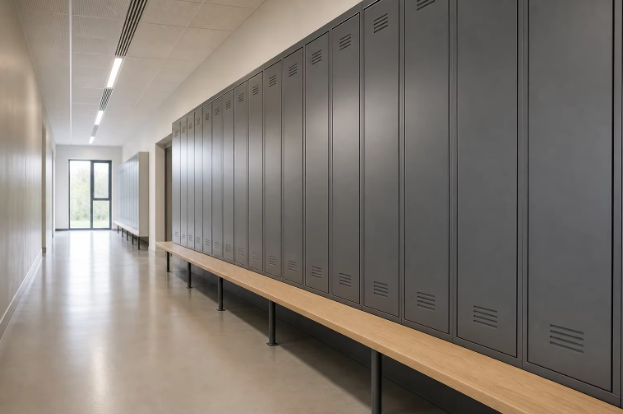
Steel lockers remain the default for general corridors: they are strong, repairable and take a powder-coated finish that hides scuffs well. Choose the steel gauge carefully, because door stiffness is what a locker is judged on after a few years of use. Laminate-faced lockers give a warmer, quieter finish that suits primary schools and sixth-form areas, but the substrate matters more than the facing.
Phenolic core panels are the usual choice where moisture is constant — changing rooms, sports blocks, swimming pool areas — because the core itself resists water rather than relying on a coating. Whatever the body, specify the door and frame tolerance, the hinge type, and whether doors are welded or assembled, since these decide how well the bank still closes after a season.
Tier layout is a space and usage decision. Single-tier units suit coats, bags and instrument cases. Double-tier units give two users per footprint and are common in secondary corridors. Three- and four-tier units are tray or shoe storage rather than hanging space, and are better placed where students pass rather than queue.
Decide the lock type before the layout: cam lock, padlock hasp, mechanical combination, or electronic.
Keyed-alike groups reduce key numbers per student cohort; a master suite keeps staff access simple.
Hold a stock of spare cylinders and keys so a lost key is a same-day fix.
Confirm whether lock bodies can be rekeyed in place or need door removal.
Ventilated doors, typically louvred or perforated top and bottom, allow air to move through wet coats and PE kit and are the cheapest way to limit damp and odor. Sloped tops on a tall bank reduce dust and stop items being placed on top.
Bench integration has to be decided early: a bench bolted between two banks needs a wider footprint and a fixing method suited to the floor. Finally, check corridor width and fire route requirements — lockers must not project into an escape route, must be fixed back to the wall against tipping, and should sit flush where a doorway, alarm panel or extinguisher needs clear access.
Match the body to the environment: steel for general corridors, phenolic for constant moisture.
Choose the lock type before finalizing tier layout and key groups.
Ventilated doors and sloped tops reduce damp, odor and dust.
Confirm fire route clearance, wall fixings and bench integration at design stage.




Copyright www.hzfgfurniture.com. All Rights Reserved. 浙ICP备2026006019号
