

-
Download
Certificate Query
Certificate Query

 2026/9/11 16:53:39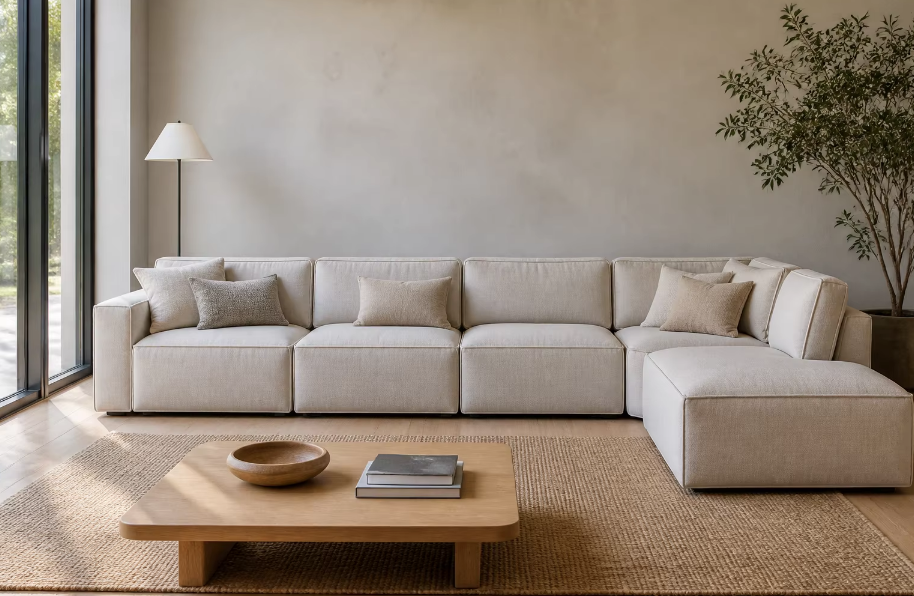
Buyers who order modular sofas rarely buy a single piece. They buy a system: seats, corners, armless middles, ottomans and end units that must combine into several finished configurations. The first decision in modular sofa sourcing is therefore the module map — the fixed set of units a factory can produce, and the way they connect. A clear map lets a retailer offer corner groups, straight runs and single seats from the same production line without new patterns or new approvals.
Connectors do more for cost control than any other component. Bracket-and-bolt sets, interlocking metal clips and simple strap links each require different fixtures and different assembly instructions. Because every unique module needs its own cutting pattern, frame jig and foam mould, limiting the module count is the fastest way to reduce tooling investment. Factories usually quote lower unit prices when a buyer accepts the standard module set and varies only fabric, leg style or seat depth.
Packing volume also matters. Modular units nest and stack more efficiently than a fixed three-seater, which can improve container utilisation, but only if the buyer accepts flat or semi-knocked-down packing and assembly at destination.
Fabric continuity is the quiet risk in a modular programme. Dye lots shift over time, so modules ordered months apart can arrive in slightly different tones. Sensible buyers place a single opening order, reserve fabric for the whole programme, and ask the supplier to record the exact fabric batch and construction for future repeats.
Replacement modules deserve the same planning:
confirm that individual units can be reordered as spares
ask whether covers can be supplied separately from foam and frames
keep at least one spare connector set per configuration
agree a realistic reorder lead time in writing
Without spares, a single damaged corner unit can take a whole group out of service.
Define the module map first; it drives tooling, unit price and lead time.
Fewer unique modules mean lower tooling investment and simpler spare-part management.
Reserve fabric early to keep colour consistent across repeat orders.
Ask suppliers to quote spares and connectors as part of the original programme.




Copyright www.hzfgfurniture.com. All Rights Reserved. 浙ICP备2026006019号
