

-
Download
Certificate Query
Certificate Query

 2026/9/11 16:46:41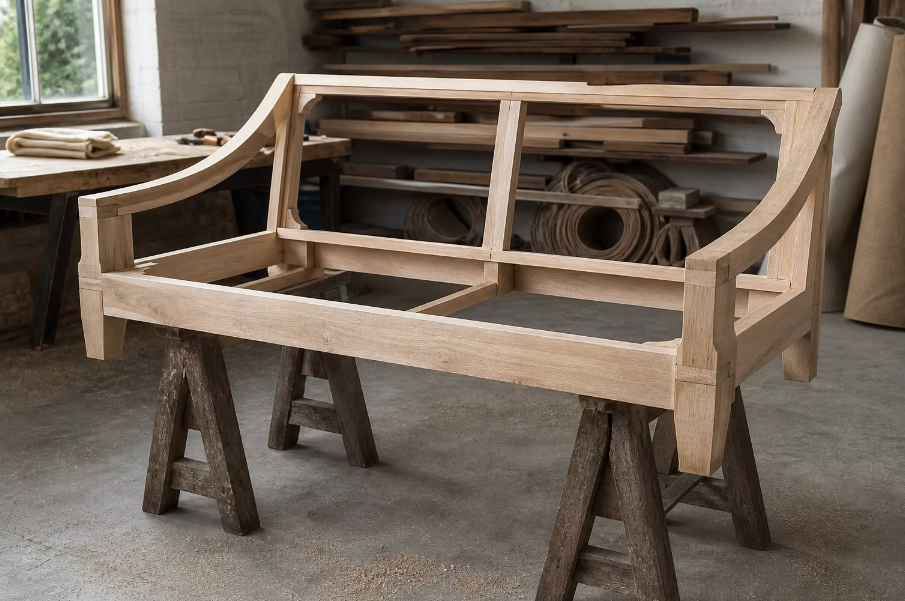
Buyers rarely see a sofa frame, yet it governs how the piece behaves after years of sitting. A frame that resists racking and holds its joints keeps cushions aligned, prevents a sagging seat platform and reduces the returns that damage a retail program. Frame material and joinery are therefore the first specification to settle, ahead of fabric, foam or finish.
For volume programs, treat frame construction as a cost-versus-lifespan decision rather than a quality slogan. Two sofas can look identical in a showroom and diverge once they are used daily.
Kiln-dried hardwood, commonly rubberwood, beech or a similar dense species, machines cleanly, holds screws and staples predictably and takes glue well. It is heavier and more expensive, and its performance depends on the moisture content of the timber at assembly.
Plywood is an engineered panel of crossed veneer layers. Cross-grain construction resists warping and splitting, which makes it sensible for curved rails and for parts where dimensional stability matters more than traditional joinery.
Particle board and other low-density composites are the weakest choice for structural rails. Screws and staples lose grip once the board crumbles, so these panels suit low-stress parts rather than load-bearing arms and seat rails.
Material alone does not decide durability. Glued and screwed corner blocks, or doweled and mortise-and-tenon joints at the front rail, do much of the work that keeps a frame square, and fasteners used on their own are a warning sign.
Moisture is the other variable. Timber that is not dried to a stable moisture content can move after assembly, opening joints or splitting rails. Frames shipped through humid routes and stored in unconditioned warehouses are especially exposed, so ask how timber is stored and what moisture range the factory targets.
Confirming the specification takes little time. Request a frame drawing naming the species or panel type for each structural part, ask for photographs or video of an unupholstered frame and of the corner block detail, then press the front rail and twist the arms gently on a sample. Where a supplier cannot describe the frame, treat the specification as unconfirmed.
Frame material and joinery decide how a sofa ages, not its cover fabric
Kiln-dried hardwood holds fasteners best, plywood adds stability, particle board is the weakest structural option
Corner blocks, adhesive and mechanical joints matter as much as species
Confirm the frame specification before ordering with drawings, unupholstered photos and a physical sample




Copyright www.hzfgfurniture.com. All Rights Reserved. 浙ICP备2026006019号
