

-
Download
Certificate Query
Certificate Query

 2026/9/11 16:18:55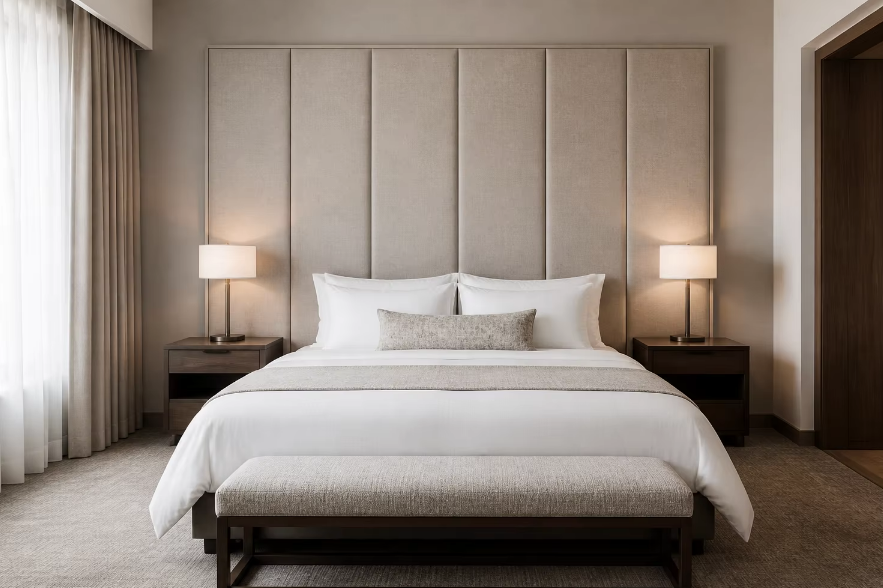
Upholstered headboards dominate hotel work because they absorb sound and hide the joint between bed and wall. The construction question is what sits under the fabric. A hardwood or engineered plywood substrate holds staples and stays flat, while a foam-only board can bow over time. Ask for the substrate species and thickness, then ask how the foam is bonded, because adhesive choice affects whether the panel survives humid corridors and steam-cleaned rooms.
Rigid boards in veneer, laminate or lacquered wood suit projects where cleaning speed matters more than softness. They resist staining, tolerate aggressive wiping and show wear less than pale fabric. The trade-off is acoustics and comfort for guests who read in bed.
Wall-mounted panels save floor area and let housekeeping vacuum or mop without moving anything. The catch is the wall behind them. Drywall, plaster on block, concrete and metal stud all take different anchors, and a padded panel is heavier than it looks. Confirm the fixing method is matched to the actual site wall rather than to a typical wall.
Floor-standing headboards rest on the floor and are simpler to install in retrofits where the wall structure is unknown. They must be restrained so a guest leaning back cannot shift the bed, and they need clearance so the base does not trap moisture during floor cleaning.
Height is usually driven by the bed platform and the ceiling. A panel that finishes well above the mattress reads generous; one that stops just above it can make a room feel tight. Wider beds normally suit a wider panel, and a shallow return helps the upholstery hold its shape. Padding depth is a comfort-versus-maintenance decision: a thin layer keeps the line crisp and cleans quickly, while a deeper layer feels more generous and traps more dust. Tight weaves also release marks better than loose textures.
Ask for the full fixing schedule, including any bracket or cleat, its load rating and the recommended fastener for each wall type. On repeat hotel models, standardising the bracket keeps spare panels interchangeable between floors. Cleaning routines and fabric-safe solvents should also be agreed before delivery. Upholstered panels can often be re-covered over the original substrate, which costs far less than replacing the whole unit.
The substrate, not the fabric, decides whether a headboard stays flat in service.
Match the fixing schedule to the actual wall construction found on site.
Judge height against the bed platform and ceiling, never in isolation.
Agree cleaning and re-covering methods before the purchase order is placed.




Copyright www.hzfgfurniture.com. All Rights Reserved. 浙ICP备2026006019号
