

-
Download
Certificate Query
Certificate Query

 2026/9/11 15:21:16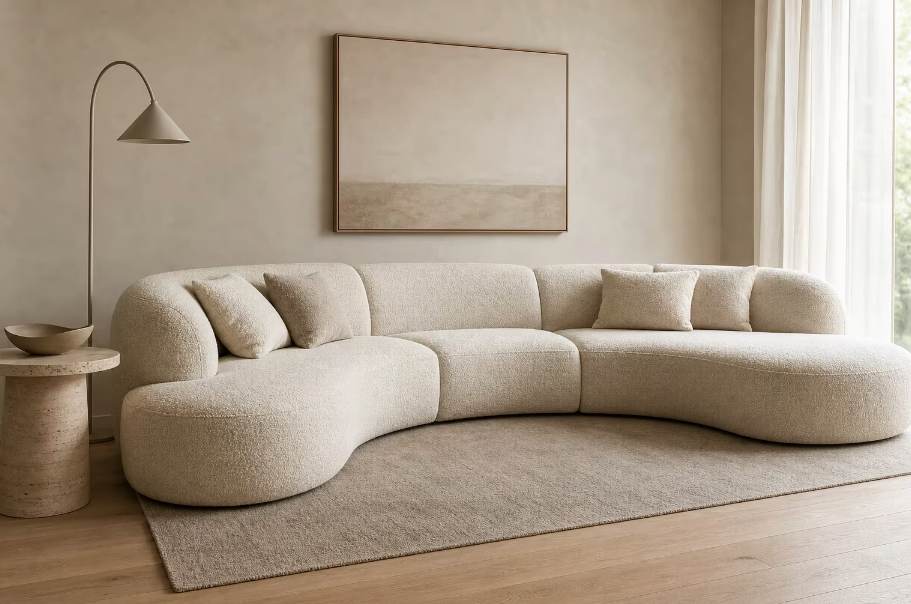
The trend: Sectionals assembled from independent modules — corner units, single seats, chaise ends, ottomans — letting the end customer configure length and shape.
What it means for your order:
Fix the module count and connector system in the specification, including whether connectors are replaceable.
A single module can be replaced instead of the whole sofa, so damage claims shrink — a strong retail argument.
Packing volume grows: more cartons, more handling, more container slots per unit.
Every inter-module joinery point is a potential failure point; specify the hardware and test it under load.
Involve freight and warehouse teams early, since module dimensions drive pallet and container plans.
The trend: Barrel, serpentine and crescent forms replacing hard-right-angle sectionals, with the curve running through the back, arms and seat platform.
What it means for your order:
Curved frames need different tooling and higher upholstery skill. Fabric must be cut on the bias or in curved panels, and sewers must control stretch and distortion.
A low-cost supplier without curved-frame experience usually shows it as rippled fabric, uneven piping and misaligned seams.
Curved modules pack less efficiently than rectangular ones, so freight cost per unit rises.
Ask for a physical sample of the curved arm or back corner before committing to volume.
The trend: Lower backs, deeper seats and generous platforms, often with a thick seat cushion on a slim base.
What it means for your order:
Deep seats need higher foam volumes and firmer support layers to avoid bottoming out, which raises material cost.
Deep, low sofas require deeper cartons and stack less efficiently.
Specify seat depth explicitly — it changes both ergonomics and packing.
The trend: Cream, sand, clay, mushroom, olive and warm gray replacing cool grays and stark whites.
What it means for your order:
Warm neutrals hide soil better than near-white but show oil and body transfer more than mid-tones.
Confirm color under two light temperatures; warm neutrals shift noticeably between daylight and warm indoor lighting.
Keep a physical approved swatch — digital renders of warm neutrals are unreliable for color matching.
The trend: A two-tone body, contrasting piping along the seams, or a contrasting base framing the upholstery.
What it means for your order:
Contrast piping raises labor content and demands precise seam alignment — a visible QC point on every unit.
Two-tone programs double fabric article management; confirm both articles are held for replacements and spare covers.
Specify exactly which seams carry the contrast and how wide the piping should be.
The trend: Exposed wood or metal frames holding soft upholstered cushions, with the structure deliberately visible.
What it means for your order:
Visible frames mean visible joinery: every joint becomes a showroom surface, so finishing standards rise.
Wood frames must be dried and finished to resist humidity during ocean transit.
Metal frames need consistent welding and coating; confirm the coating process rather than accepting a general description.
The trend: Two-seat and apartment-scale sofas with high legs or floating bases and shallow footprints.
What it means for your order:
These designs reward flat-packing and efficient carton design — high value per container slot.
Slim profiles need firm, thin cushions; specify higher-resilience foam so thin seats do not collapse.
Small sofas pair well with e-commerce fulfillment, since parcel dimensions can be standardized.




Copyright www.hzfgfurniture.com. All Rights Reserved. 浙ICP备2026006019号
